注記(区切り記号について)
この翻訳文には、点字に対応させるための区切り記号(マス空け)を入れています。
「」 … 1マスあけ
「」 … 2マスあけ
点訳の際に必要となる区切りを、見える形で示しています。
読み進めるうちに、文章のリズムや切れ目を意識していただければ幸いです。
・固有名詞は実際の発音を標準にしますが、日本語で馴染みのあるカタカナ表記を優先しています。
・固有名詞は、原則として最初に登場した時に限って、その固有部分を「第2カギ符」で囲んでいます。
・固有名詞の複合語は、「マス空け」「中点」ではなく、一つの意味のまとまりとして一体性を保つために「第2つなぎ符」で表記しています。
・建物の階数は日本式で、ground floor=一階、first floor=二階と表記しています。
『Brille Editor System ver.8』用の『BESファイル』を、ZIPファイルに圧縮して公開しています。(2026年1月20日現在)
The Mysterious Affair at Styles
CHAPTER Ⅳ.
POIROT INVESTIGATES
スタイルズの怪事件
第四章
ポワロの捜査
The house which the Belgians occupied in the village was quite close to the park gates.
One could save time by taking a narrow path through the long grass, which cut off the detours of the winding drive.
So I, accordingly, went that way.
I had nearly reached the lodge, when my attention was arrested by the running figure of a man approaching me.
It was Mr. Inglethorp. Where had he been? How did he intend to explain his absence?
He accosted me eagerly.
ベルギー人たちが村で住んでいた家は、公園の門のすぐ近くにあった。
長い草の中を通る細い小道を行けば、曲がりくねった車道を大きく回る必要がなく、時間を節約できた。
それゆえ、私はその道を通ることにした。
門番小屋にほとんど到着しかけたとき、私の注意は、こちらに向かって走ってくる一人の男の姿に引きつけられた。
それはミスター=イングルソープだった。
彼はどこにいたのだろう?
この不在をどのように説明するつもりなのだろうか?
彼は私にしきりに話しかけてきた。

“My God! This is terrible! My poor wife! I have only just heard.”
「なんということだ!ひどい!可哀想な妻だ!私はちょうど聞いたばかりなのです」

“Where have you been?” I asked.
「どこにいたのですか?」
私は尋ねた。
“Denby kept me late last night.
It was one o’clock before we’d finished.
Then I found that I’d forgotten the latch-key after all.
I didn’t want to arouse the household, so Denby gave me a bed.”
「昨夜は<デンビー>が遅くまで引き止めましてね。終わったのは1時でした。その時になってようやく鍵を忘れたことに気づいたんです。
家族を起こしたくなかったもので、それでデンビーが泊めてくれたんですよ」
“How did you hear the news?” I asked.
「どうやってその知らせを聞いたんですか?」
私はさらに尋ねた。
“Wilkins knocked Denby up to tell him.
My poor Emily!
She was so self-sacrificing—such a noble character.
She over-taxed her strength.”
「ウィルキンスがデンビーの家まで来て、教えてくれたんです。かわいそうなエミリー!彼女は本当に献身的な人でした。気高い人格者だったから、頑張りすぎたんです」
A wave of revulsion swept over me. What a consummate hypocrite the man was!
私は強い嫌悪感に襲われた。この男は、なんという偽善者なのだ!
“I must hurry on,” I said, thankful that he did not ask me whither I was bound.
「急いでますので」と、私は言った。彼が私の行き先を尋ねてこなかったことに感謝しながら。
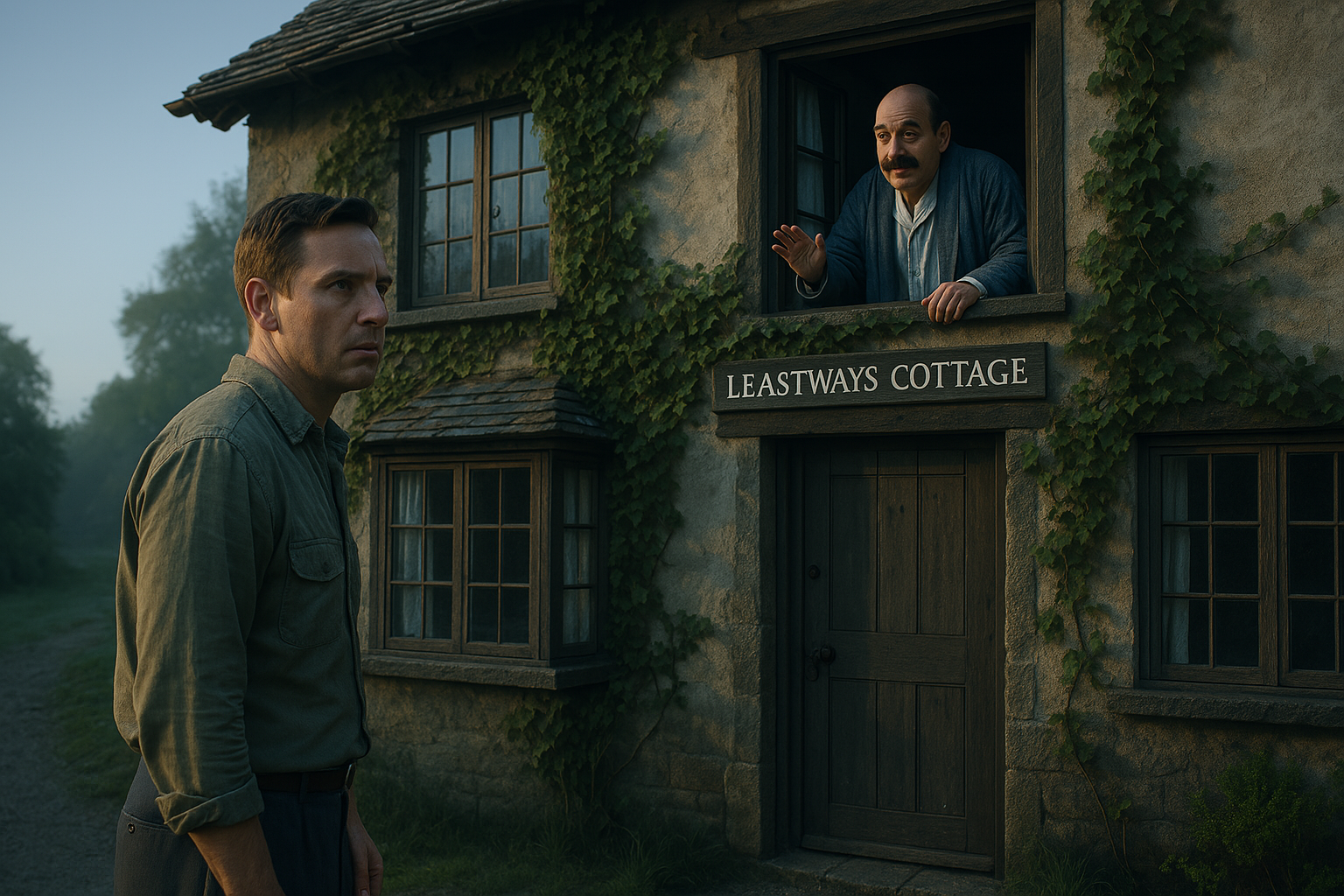
In a few minutes I was knocking at the door of Leastways Cottage.Getting no answer, I repeated my summons impatiently.
A window above me was cautiously opened, and Poirot himself looked out.
He gave an exclamation of surprise at seeing me. In a few brief words, I explained the tragedy that had occurred, and that I wanted his help.
数分後、私は<リーズトウェイズ=コテージ>のドアをノックしていた。
返事がなかったので、私は苛立ちながら再びノックを繰り返した。すると、二階の窓が用心深く開き、ポワロ自身が顔を出した。
私の姿を見ると、彼は驚きの声をあげた。私は簡潔に事件の内容と、彼の助けが必要だということを伝えた。

“Wait, my friend, I will let you in, and you shall recount to me the affair whilst I dress.”
「待っていてくれ、きみ。中に入れてあげるから。私が着替えている間に詳しく話してくれ」
In a few moments he had unbarred the door, and I followed him up to his room. There he installed me in a chair, and I related the whole story, keeping back nothing, and omitting no circumstance, however insignificant, whilst he himself made a careful and deliberate toilet.
I told him of my awakening, of Mrs. Inglethorp’s dying words, of her husband’s absence, of the quarrel the day before, of the scrap of conversation between Mary and her mother-in-law that I had overheard, of the former quarrel between Mrs. Inglethorp and Evelyn Howard, and of the latter’s innuendoes.
I was hardly as clear as I could wish. I repeated myself several times, and occasionally had to go back to some detail that I had forgotten. Poirot smiled kindly on me.
数分後、彼はドアのかんぬきを外し、私は彼の部屋へとついて行った。彼は私を椅子に座らせ、私は一切を包み隠さずに話した。どんなに些細に思えることも省略せずに。ポワロは丁寧に身支度を整えながら、私の話に耳を傾けた。
私は自分が目を覚ましたこと、ミセス=イングルソープの最後の言葉、夫の不在、前日の口論、メアリーとミセス=イングルソープの会話の一部を偶然聞いたこと、その前のイヴリン=ハワードとの争い、そして彼女の含みのある発言について語った。
私の話は思うように整理されていなかった。何度も繰り返したり、思い出して後戻りしたりした。ポワロは優しく微笑んだ。
“The mind is confused? Is it not so? Take time, mon ami. You are agitated; you are excited—it is but natural. Presently, when we are calmer, we will arrange the facts, neatly, each in his proper place.
We will examine—and reject. Those of importance we will put on one side; those of no importance, pouf!”
「混乱しているのだね? そうだろう? 落ち着くんだ、モナミ。君は動揺しているし、興奮している。それは当然のことだ。落ち着いたら、事実をきちんと整理しよう。順序よく、それぞれただしい場所に置くんだ。検証して、そしてふるいにかける。重要なものは残す。そうでないものは、ぷっ!」
—he screwed up his cherub-like face, and puffed comically enough—
彼は、小さな天使のような顔をしかめ、滑稽に頬を膨らませて、ぷっと吹く真似をしながら言った。
“blow them away!”
「吹き飛ばすのだ!」
“That’s all very well,” I objected, “but how are you going to decide what is important, and what isn’t? That always seems the difficulty to me.”
「それはその通りなんだけど」と、私は異議を唱えた。
「何が重要で、何が重要でないかをどうやって決めるんだ? いつもそこが難しいと思う」
Poirot shook his head energetically. He was now arranging his moustache with exquisite care.
ポワロは勢いよく首を振った。彼は今、髭を丁寧に整えていた。
“Not so. Voyons!
One fact leads to another—so we continue. Does the next fit in with that?
A merveille! Good!
We can proceed. This next little fact—no! Ah, that is curious! There is something missing—a link in the chain that is not there. We examine. We search.
And that little curious fact, that possibly paltry little detail that will not tally, we put it here!”
「そうではない。ヴワヨン(いいかね)!一つの事実が別の事実につながる。そこから続ける。その次の事実が合致するか?アメルヴェイユ(素晴らしい)!よし!進もう。次の小さな事実は、いや、違う!それはおかしい!何かが欠けていて、鎖がつながらないのだ。我々は調べる。探す。そして、その小さくて一見くだらないような合わない事実、それをここに置く!」
“Not so. Voyons!
One fact leads to another—so we continue. Does the next fit in with that?
A merveille! Good!
We can proceed. This next little fact—no! Ah, that is curious! There is something missing—a link in the chain that is not there. We examine. We search.
And that little curious fact, that possibly paltry little detail that will not tally, we put it here!” He made an extravagant gesture with his hand. “It is significant! It is tremendous!”
「そうではない。ヴワヨン(いいかね)!一つの事実が別の事実につながる。そこから続ける。その次の事実が合致するか?ア・メルヴェイユ(素晴らしい)!よし!進もう。次の小さな事実は、いや、違う!それはおかしい!何かが欠けていて、鎖がつながらないのだ。我々は調べる。探す。そして、その小さくて一見くだらないようなつながらない事実、それをここに置く!」
He made an extravagant gesture with his hand.
彼は大げさに手を振った。
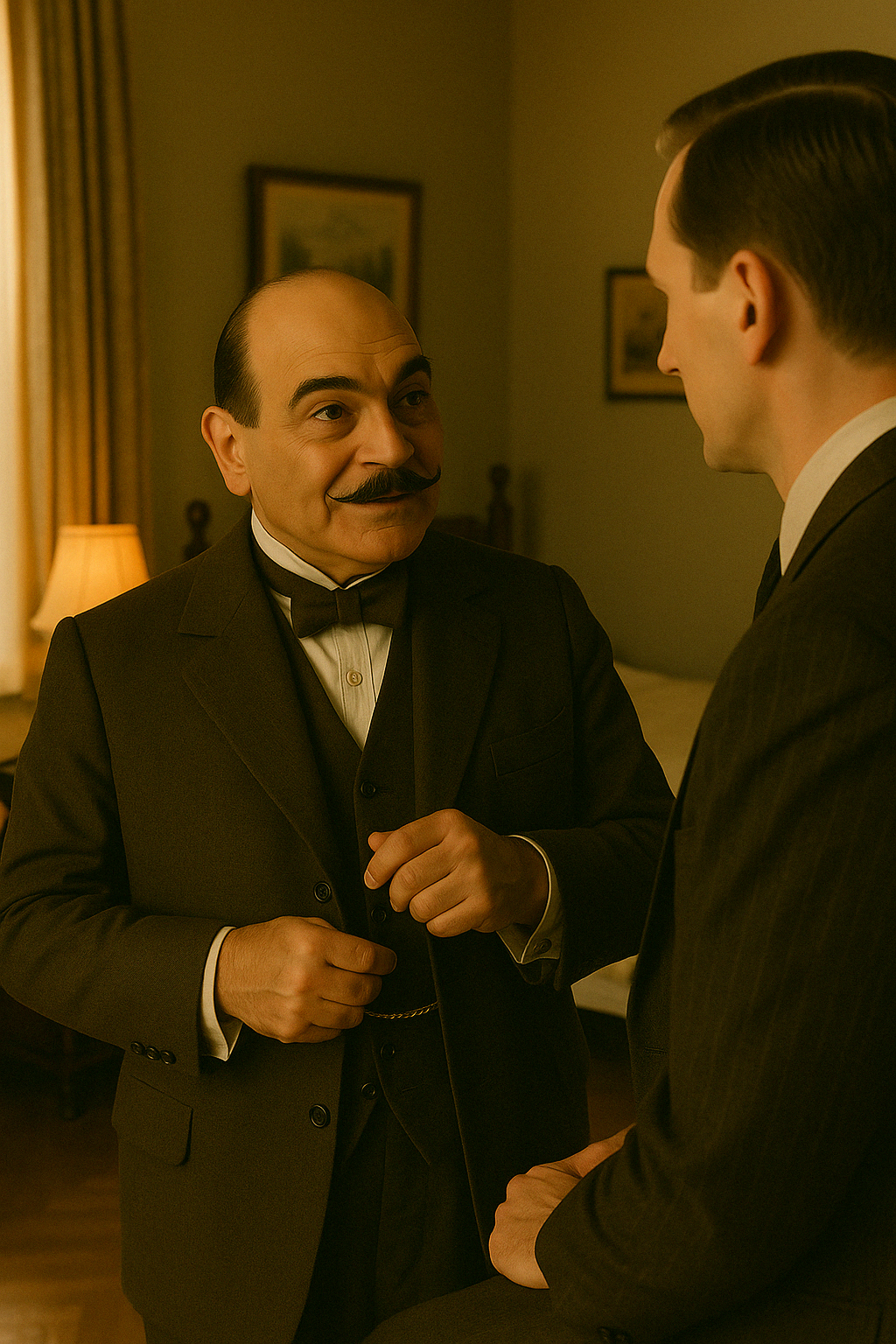
“It is significant! It is tremendous!”
「それは意味深い!とてつもなく重要なんだ!」
“Y—es——”
「そ、そうか」
“Ah!”
「そう!」
Poirot shook his forefinger so fiercely at me that I quailed before it.
ポワロは私に向かって人差し指を激しく振り回したので、私は思わず身をすくめた。
“Beware! Peril to the detective who says: ‘It is so small—it does not matter. It will not agree. I will forget it.’ That way lies confusion! Everything matters.”
「気をつけるんだ!『些細なことだ、重要ではない、一致しない、忘れよう』と言ってしまう探偵は危険なのだ!そこには混乱しか待っていない!すべてが重要なのだ!」
“I know. You always told me that. That’s why I have gone into all the details of this thing whether they seemed to me relevant or not.”
「わかってる。君はいつもそう言ってた。それで僕は、関係ありそうでもなさそうでも全部話したんだ」
“And I am pleased with you. You have a good memory, and you have given me the facts faithfully. Of the order in which you present them, I say nothing—truly, it is deplorable!
But I make allowances—you are upset. To that I attribute the circumstance that you have omitted one fact of paramount importance.”
「それは嬉しいかぎりだ。君は記憶力が良く、事実をきちんと正確に伝えてくれた。順序については何も言うまい。まあ、ひどいものだ!でもそこは大目にみよう。君は取り乱していたからね。だからこそ、君が一つだけ極めて重要な事実を抜かしていたことも、私は理解できる」
“What is that?” I asked.
「それは何だ?」
私は尋ねた。
“You have not told me if Mrs. Inglethorp ate well last night.”
「ミセス=イングルソープが昨夜、夕食をよく食べていたかどうか、それを君は言っていない」
I stared at him. Surely the war had affected the little man’s brain.
He was carefully engaged in brushing his coat before putting it on, and seemed wholly engrossed in the task.
私は彼を見つめた。きっと戦争は、この小男の頭にも影響を与えたのだろう。
彼は丁寧に外套の埃を払っており、その作業に完全に集中しているようだった。
“I don’t remember,” I said.
“And, anyway, I don’t see——”
「覚えていない」と、私は言った。
「それに、意味があるとは思えない」
“You do not see? But it is of the first importance.”
「意味がないと?だが、それは極めて重要なことなのだ」
“I can’t see why,” I said, rather nettled.
“As far as I can remember, she didn’t eat much. She was obviously upset, and it had taken her appetite away. That was only natural.”
「なぜだかわからないよ」と、私は少し苛立ち気味に言った。
「僕の記憶では、あまり食べていなかったと思う。明らかに動揺していて、食欲がなかった。それは自然なことだろう?」
“Yes,” said Poirot thoughtfully, “it was only natural.”
「そうだ」と、ポワロは考え込んで言った。
「それは自然なことだ」
He opened a drawer, and took out a small despatch-case, then turned to me.
彼は引き出しを開け、小さな書類鞄を取り出すと、私の方を向いた。
“Now I am ready. We will proceed to the château, and study matters on the spot. Excuse me, mon ami, you dressed in haste, and your tie is on one side. Permit me.”
「さあ、準備は整った。これからお屋敷へ行って、現場で事実を検証しよう。失礼、モナミ、君は急いで着替えたようだね。ネクタイが少しずれている。ちょっと失礼」
With a deft gesture, he rearranged it.
彼は巧みに僕のネクタイを直した。
“Ça y est! Now, shall we start?”
「サイエ(さあ、これで完璧)!では、出発しようか?」
We hurried up the village, and turned in at the lodge gates.
Poirot stopped for a moment, and gazed sorrowfully over the beautiful expanse of park, still glittering with morning dew.
私たちは急いで村を通り抜け、門番小屋の門をくぐった。
ポワロはしばらく立ち止まり、まだ、朝露にきらめく美しい公園の広がりを悲しげに見つめた。
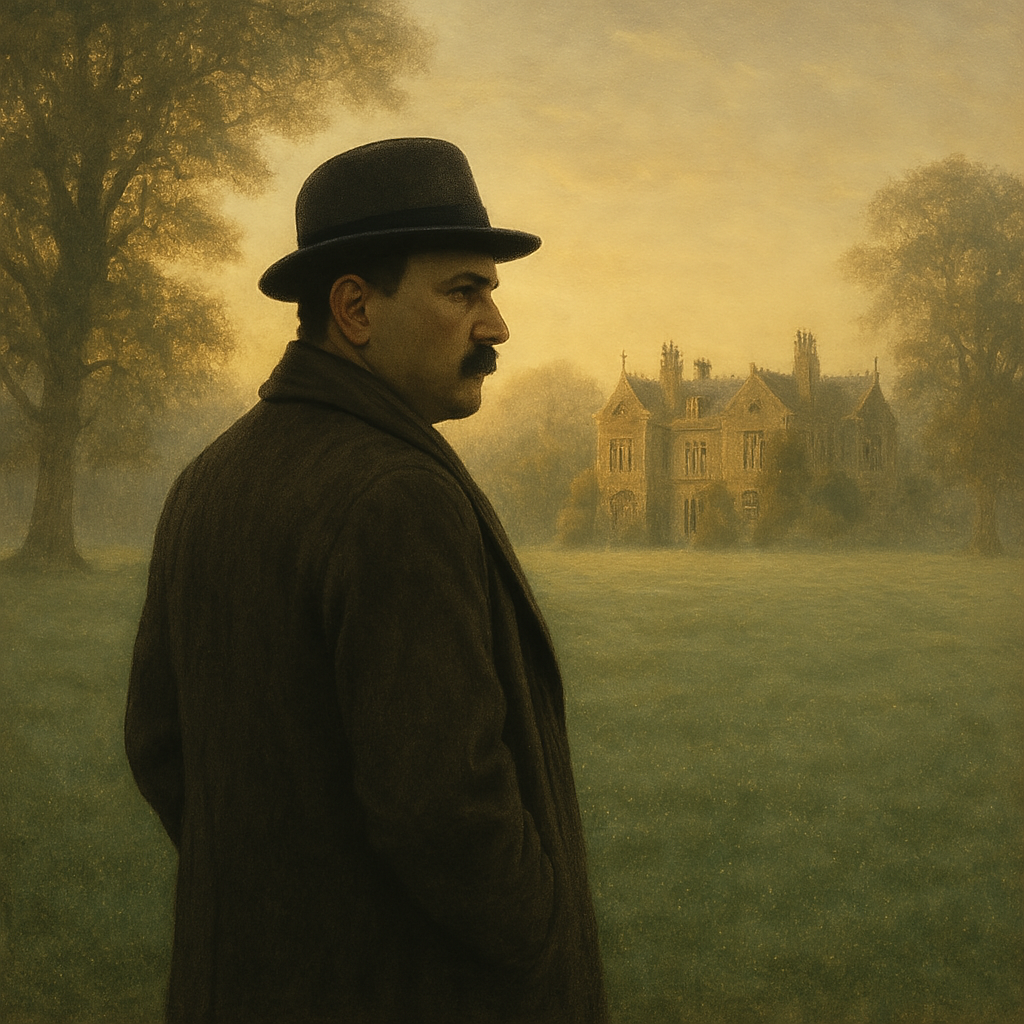

“So beautiful, so beautiful, and yet, the poor family, plunged in sorrow, prostrated with grief.”
「とても美しい。とても美しい。だが、哀れな家族は深い悲しみに沈み、打ちひしがれている」
He looked at me keenly as he spoke, and I was aware that I reddened under his prolonged gaze.
Was the family prostrated by grief?
Was the sorrow at Mrs. Inglethorp’s death so great?
I realized that there was an emotional lack in the atmosphere.
The dead woman had not the gift of commanding love.
Her death was a shock and a distress, but she would not be passionately regretted.
彼はそう言いながら鋭いまなざしで私を見つめ、私はその視線の強さに思わず顔が赤らむのを感じた。
本当に家族は悲しみに打ちひしがれているのだろうか?
ミセス=イングルソープの死を、彼らはそんなにも深く悲しんでいるのだろうか?
私はふと、周囲の空気に感情の欠如を感じ取った。亡くなった彼女には、人の心を惹きつけるような愛情を呼び起こす力がなかったのだ。
彼女の死は衝撃であり、痛ましいものではあるが、誰もが心から惜しみ、激しく嘆くようなものではなかった。
Poirot seemed to follow my thoughts. He nodded his head gravely.
ポワロはまるで、私の考えを読んだかのように、深刻そうにうなずいた。
“No, you are right,” he said, “it is not as though there was a blood tie. She has been kind and generous to these Cavendishes, but she was not their own mother. Blood tells—always remember that—blood tells.”
「そう、その通りだよ」と、彼は言った。
「血のつながりがあるというわけではない。彼女はこのキャヴンディッシュたちに親切で寛大ではあったが、彼らの実の母親ではない。血はものを言う。それを忘れてはならない。血は語るのだ」
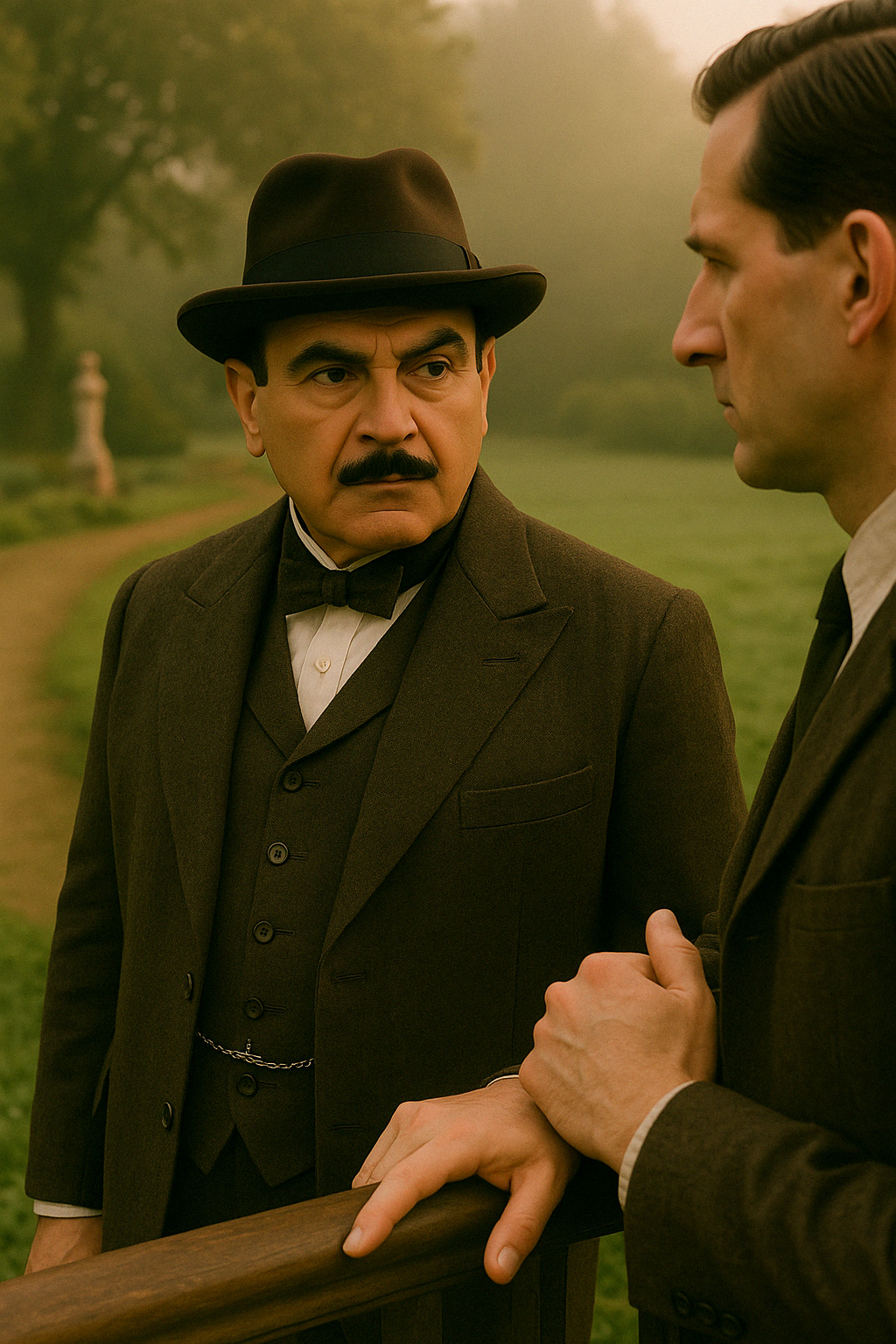
“Poirot,” I said,
“I wish you would tell me why you wanted to know if Mrs.
Inglethorp ate well last night?
I have been turning it over in my mind, but I can’t see how it has anything to do with the matter?”
「ポワロ」と、私は言った。
「なぜ昨夜ミセス=イングルソープがよく食べたかどうか、あんなに気にしていたのか、教えてくれないか?ずっと考えていたんだが、それがこの件とどう関係するのか分からないんだ」
He was silent for a minute or two as we walked along, but finally he said:
彼はしばらく沈黙してまま、我々は歩き続けたが、ようやく口を開いた。
“I do not mind telling you—though, as you know, it is not my habit to explain until the end is reached.
The present contention is that Mrs. Inglethorp died of strychnine poisoning, presumably administered in her coffee.”
「話しても構わない。ただ、君も知っての通り、私は結末に至るまで説明をするのは好まない性格なんだ。
今言えることは、ミセス=イングルソープはストリキニーネ中毒で死んだ。おそらくはコーヒーに毒が盛られていた、ということだ」
“Yes?”
「ああ、そうだけど?」
“Well, what time was the coffee served?”
「では、そのコーヒーは何時に出されたのかね?」
“About eight o’clock.”
「8時ごろだ」
“Therefore she drank it between then and half-past eight—certainly not much later.
Well, strychnine is a fairly rapid poison.
Its effects would be felt very soon, probably in about an hour.
Yet, in Mrs. Inglethorp’s case, the symptoms do not manifest themselves until five o’clock the next morning: nine hours!
But a heavy meal, taken at about the same time as the poison, might retard its effects, though hardly to that extent.
Still, it is a possibility to be taken into account.
But, according to you, she ate very little for supper, and yet the symptoms do not develop until early the next morning!
Now that is a curious circumstance, my friend.
Something may arise at the autopsy to explain it.
In the meantime, remember it.”
「つまり、彼女はその8時から8時半の間にコーヒーを飲んだはずで、遅くともそれ以降ではない。ストリキニーネは比較的即効性のある毒物だ。その効果はすぐに現れ、通常ならおよそ1時間以内に。だが、ミセス=イングルソープの場合、症状が現れたのは翌朝の5時、9時間後だ!しかし、毒と同時にしっかりとした食事を摂っていれば、その効果を遅らせることができる。とはいえ、そこまで長くは無理だ。それでも、考慮すべき可能性ではある。だが君の話によれば、彼女は夕食をほとんど食べていない。にもかかわらず、症状が現れたのは翌朝!これは奇妙な状況だよ、ねえ、君。解剖で何か明らかになるかもしれない。それまでは、この点を覚えておこう」
As we neared the house, John came out and met us. His face looked weary and haggard.
家の近くまで来ると、ジョンが出てきて私たちに会った。彼の顔は疲れ切ってやつれて見えた。
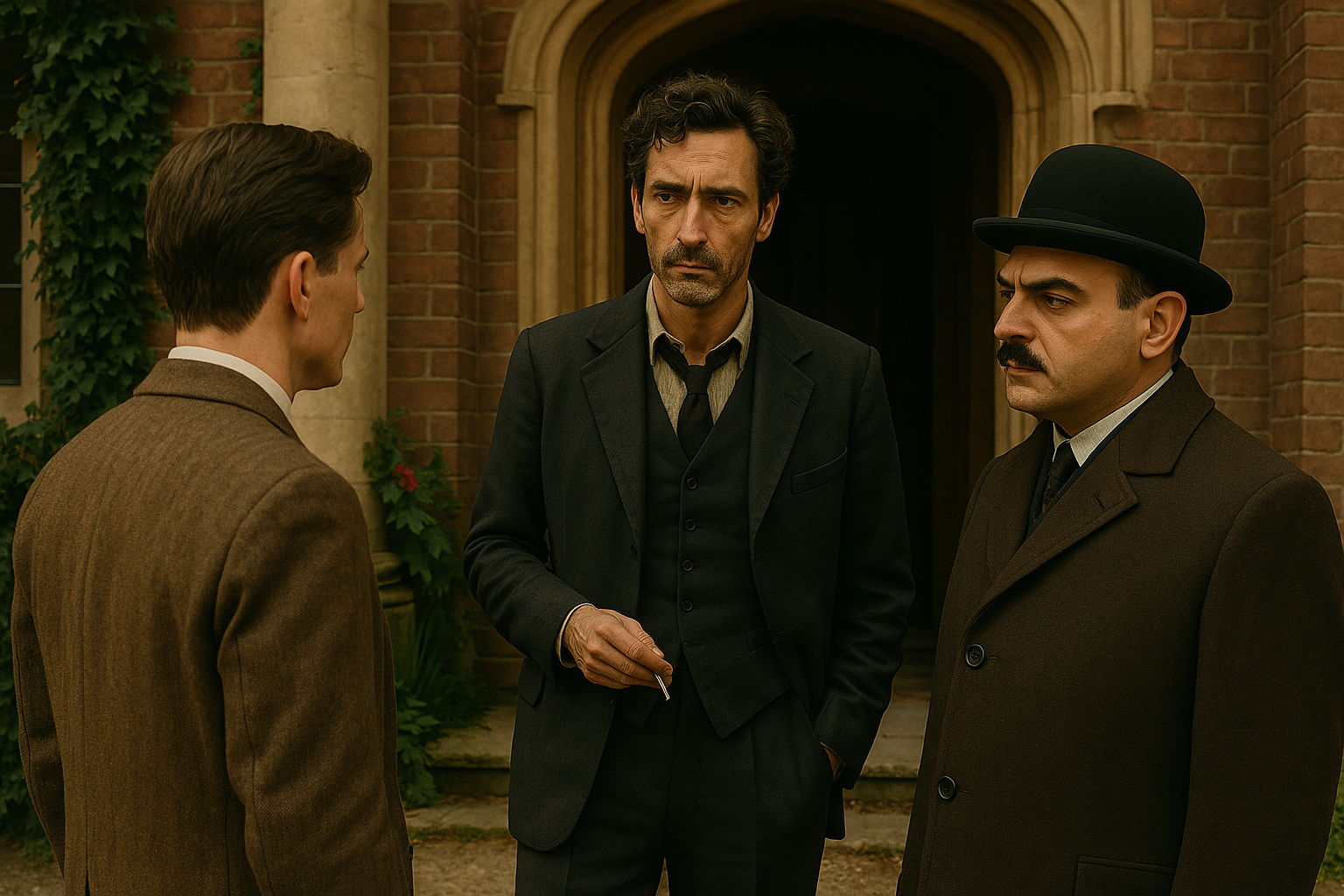

“This is a very dreadful business, Monsieur Poirot,” he said.
“Hastings has explained to you that we are anxious for no publicity?”
「これは実にひどい出来事です、ムッシュー=ポワロ」と、彼は言った。
「できるだけ公にしたくない、という話は、ヘイスティングスから聞いてますよね?」
“I comprehend perfectly.”
「もちろん、よく理解しております」

“You see, it is only suspicion so far. We have nothing to go upon.”
「というのも、まだ疑いの段階なのです。確たる証拠は何もない」

“Precisely. It is a matter of precaution only.”
「まさしく。あくまで念のためということですね」
John turned to me, taking out his cigarette-case, and lighting a cigarette as he did so.
ジョンは私の方に向き直りながら、シガレットケースを取り出して煙草に火をつけた。
“You know that fellow Inglethorp is back?”
「イングルソープのやつが戻ってきてるのは知ってるかい?」
“Yes. I met him.”
「ああ、会ったよ」
John flung the match into an adjacent flower bed, a proceeding which was too much for Poirot’s feelings. He retrieved it, and buried it neatly.
ジョンは点けたマッチを近くの花壇に投げ捨てたが、それはポワロの性格にとってあまりにも耐えがたい行為だった。
彼はそれを拾い上げ、丁寧に土に埋めた。
“It’s jolly difficult to know how to treat him.”
「やつとどう接していいか、まったく困ったものだ」
“That difficulty will not exist long,” pronounced Poirot quietly.
「そのお悩みは、そう長くは続かないでしょう」と、ポワロは静かに言った。
John looked puzzled, not quite understanding the portent of this cryptic saying. He handed the two keys which Dr. Bauerstein had given him to me.
ジョンは困惑したようにポワロを見たが、その言葉の真意までは理解できていないようだった。
彼はドクター=バウアースタインから預かっていた二本の鍵を私に手渡した。
“Show Monsieur Poirot everything he wants to see.”
「ムッシュー=ポワロに見たいものをすべて見せてあげてくれ」
“The rooms are locked?” asked Poirot.
「部屋には鍵がかかっているのですか?」と、ポワロが尋ねた。
“Dr. Bauerstein considered it advisable.”
「ドクター=バウアースタインがよく考えられて、そうするようにと」
Poirot nodded thoughtfully.
ポワロは考え深げにうなずいた。
“Then he is very sure. Well, that simplifies matters for us.”
「すると、彼はかなり確信を持っているのですね。ふむ、それなら我々にとって都合がいい」
We went up together to the room of the tragedy.
For convenience I append a plan of the room and the principal articles of furniture in it.
そして私たちは一緒に、あの悲劇の起こった部屋へと向かった。
ここに、便宜のためその部屋と主な家具の配置図を添付しておく。
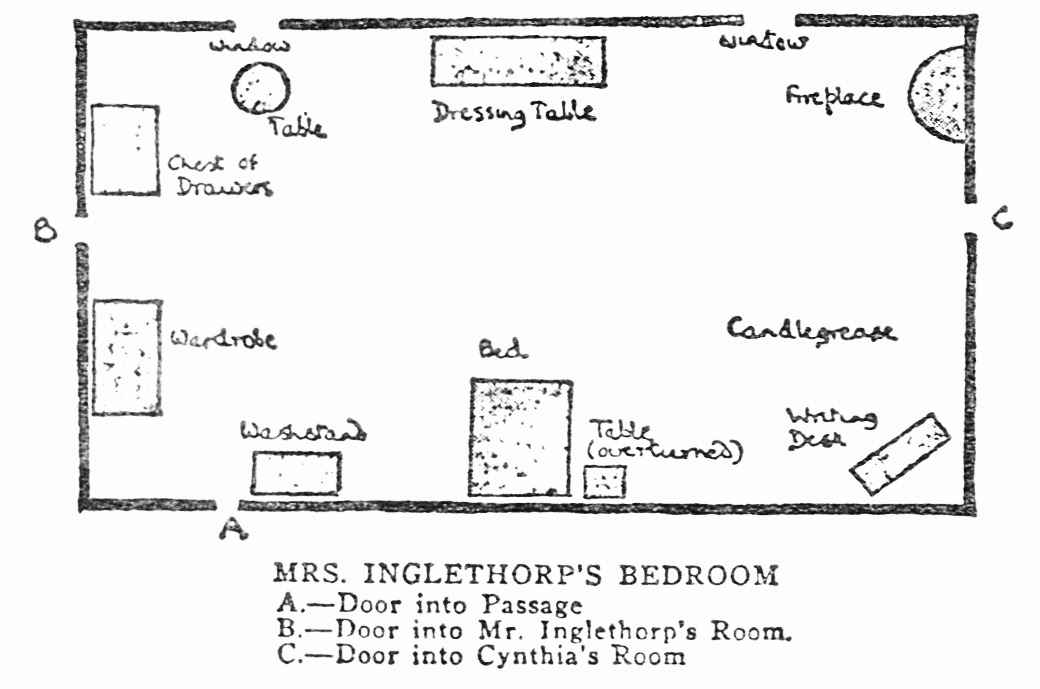
Poirot locked the door on the inside, and proceeded to a minute inspection of the room. He darted from one object to the other with the agility of a grasshopper.
I remained by the door, fearing to obliterate any clues. Poirot, however, did not seem grateful to me for my forbearance.
ポワロは部屋の内側から鍵をかけ、細かな調査に取りかかった。
彼はバッタのような素早さで、あちこちの物から物へと移動しながら調べていた。
私はドアのそばに立ったまま動かずにいた。手がかりを消してしまうのが怖かったのだ。
だがポワロは、私の慎重さに感謝しているようには見えなかった。
“What have you, my friend,” he cried,
“that you remain there like—how do you say it?—ah, yes, the stuck pig?”
「どうしたんだい、きみ!」と、彼は叫んだ。
「そんなところに突っ立って。なんといいいましたっけ?ああ、そうだ。『突き刺された豚』みたいに!」
I explained that I was afraid of obliterating any foot-marks.
私は足跡を消してしまうのを恐れていたのだと説明した。
“Foot-marks?
But what an idea!
There has already been practically an army in the room!
What foot-marks are we likely to find?
No, come here and aid me in my search.
I will put down my little case until I need it.”
「足跡ですと?何を考えてるんだ!この部屋にはすでにほとんど軍隊が踏み込んでいるようなものなんだ!いまさら何の足跡が見つかるというのだ?
さあ、こちらに来て調査を手伝いたまえ。私の鞄は必要になるまで置いておこう」
He did so, on the round table by the window, but it was an ill-advised proceeding; for, the top of it being loose, it tilted up, and precipitated the despatch-case on the floor.
そう言って、彼は窓際にある丸テーブルの上に鞄を置いた。だがそれは、愚かな行動だった。
テーブルの天板が固定されておらず、傾いてしまい、鞄は床に落ちてしまった。
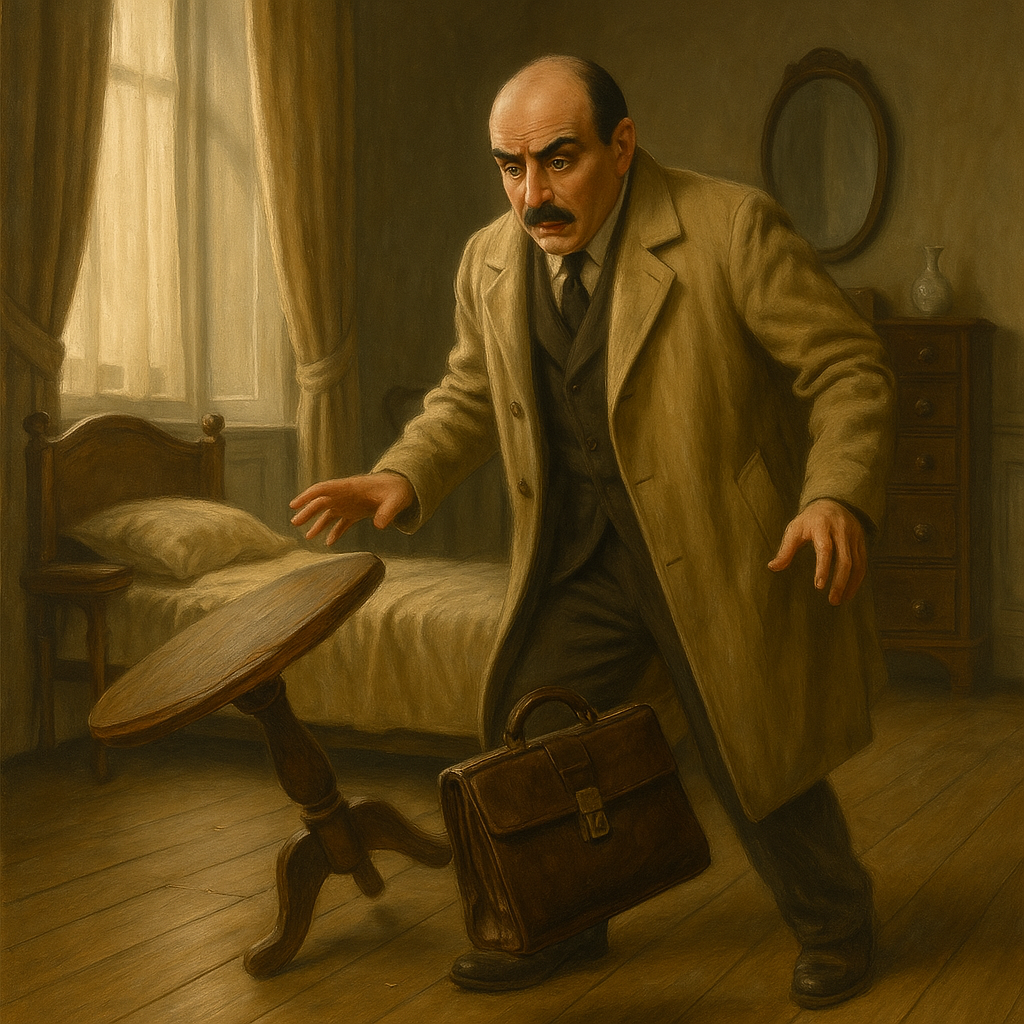
“Eh voilà une table!” cried Poirot.
“Ah, my friend, one may live in a big house and yet have no comfort.”
「エヴォワラユヌターブル(えっ、これがテーブルか)!」と、ポワロは叫んだ。
「まったく、大きな家に住んでいても、快適とは言えないもんだ」
After which piece of moralizing, he resumed his search.
A small purple despatch-case, with a key in the lock, on the writing-table, engaged his attention for some time.
He took out the key from the lock, and passed it to me to inspect. I saw nothing peculiar, however.
It was an ordinary key of the Yale type, with a bit of twisted wire through the handle.
そうして道徳的な皮肉をひとつ言い終えると、彼は再び調査に戻った。
机の上には、小さな紫色の書類鞄があり、鍵がかかったままになっていた。
彼はしばらくその鞄に注意を向けたのち、鍵を抜き取って私に手渡した。私はその鍵を見たが、特に変わったところはなかった。
それは、ごく普通のヤール式の鍵で、持ち手にはねじられた針金が通してあった。

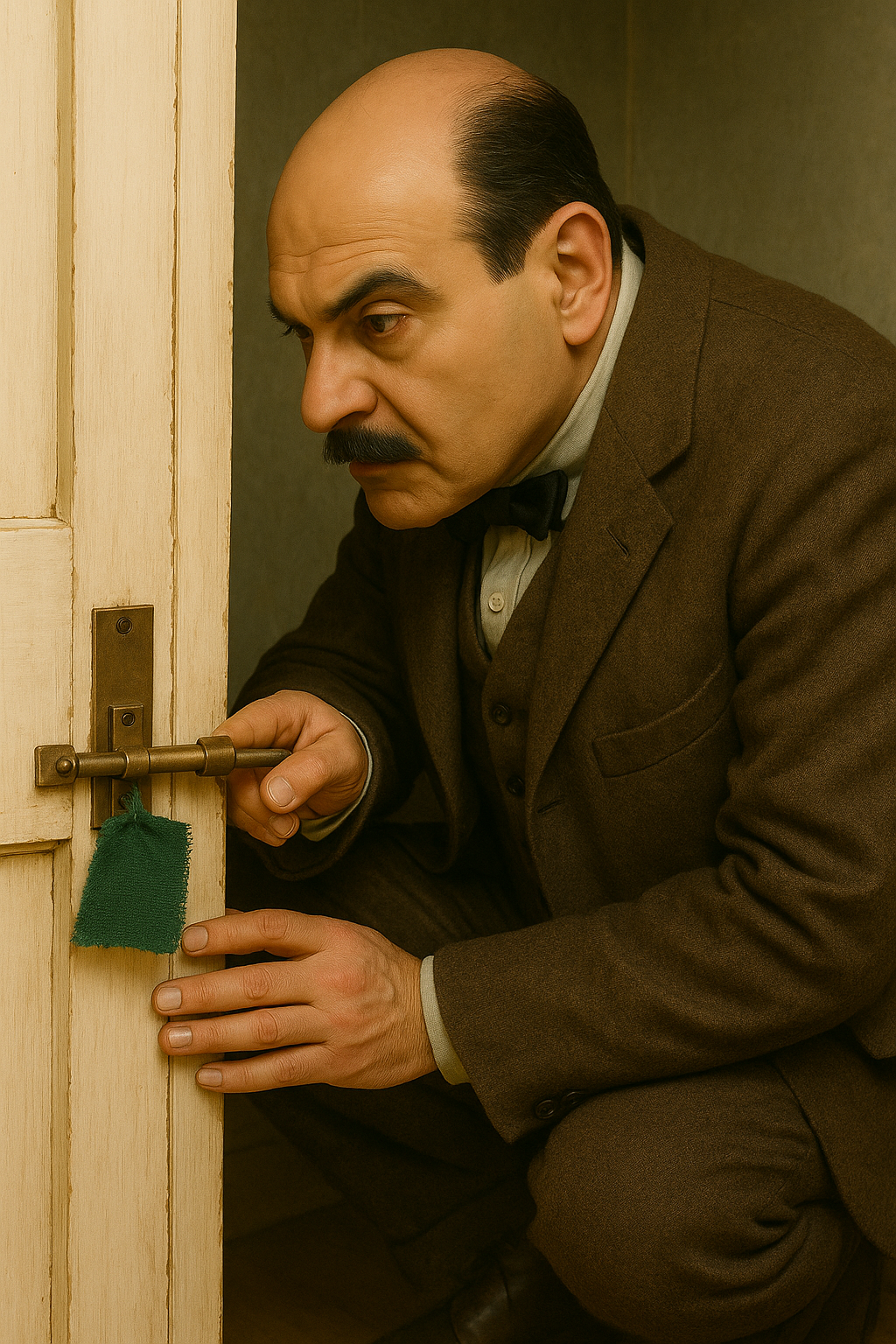
Next, he examined the framework of the door we had broken in, assuring himself that the bolt had really been shot.
Then he went to the door opposite leading into Cynthia’s room. That door was also bolted, as I had stated.
However, he went to the length of unbolting it, and opening and shutting it several times; this he did with the utmost precaution against making any noise.
Suddenly something in the bolt itself seemed to rivet his attention.
He examined it carefully, and then, nimbly whipping out a pair of small forceps from his case, he drew out some minute particle which he carefully sealed up in a tiny envelope.
次に彼は、我々がこじ開けて入ったドアの枠を調べ、かんぬきが実際にかかっていたのかを確認した。
そして反対側のシンシアの部屋へと通じるドアのほうへ行った。
このドアにも、私が言った通りかんぬきがかかっていた。
だが彼はそれを外し、音を立てないよう細心の注意を払いながら何度も開け閉めした。
突然、掛け金そのものに何かが彼の注意を引いたらしく、じっとそれを観察し始めた。
やがて彼は素早く鞄から小さなピンセットを取り出すと、ごく細かい断片をつまみ上げ、それを丁寧に小さな封筒に入れて封をした。
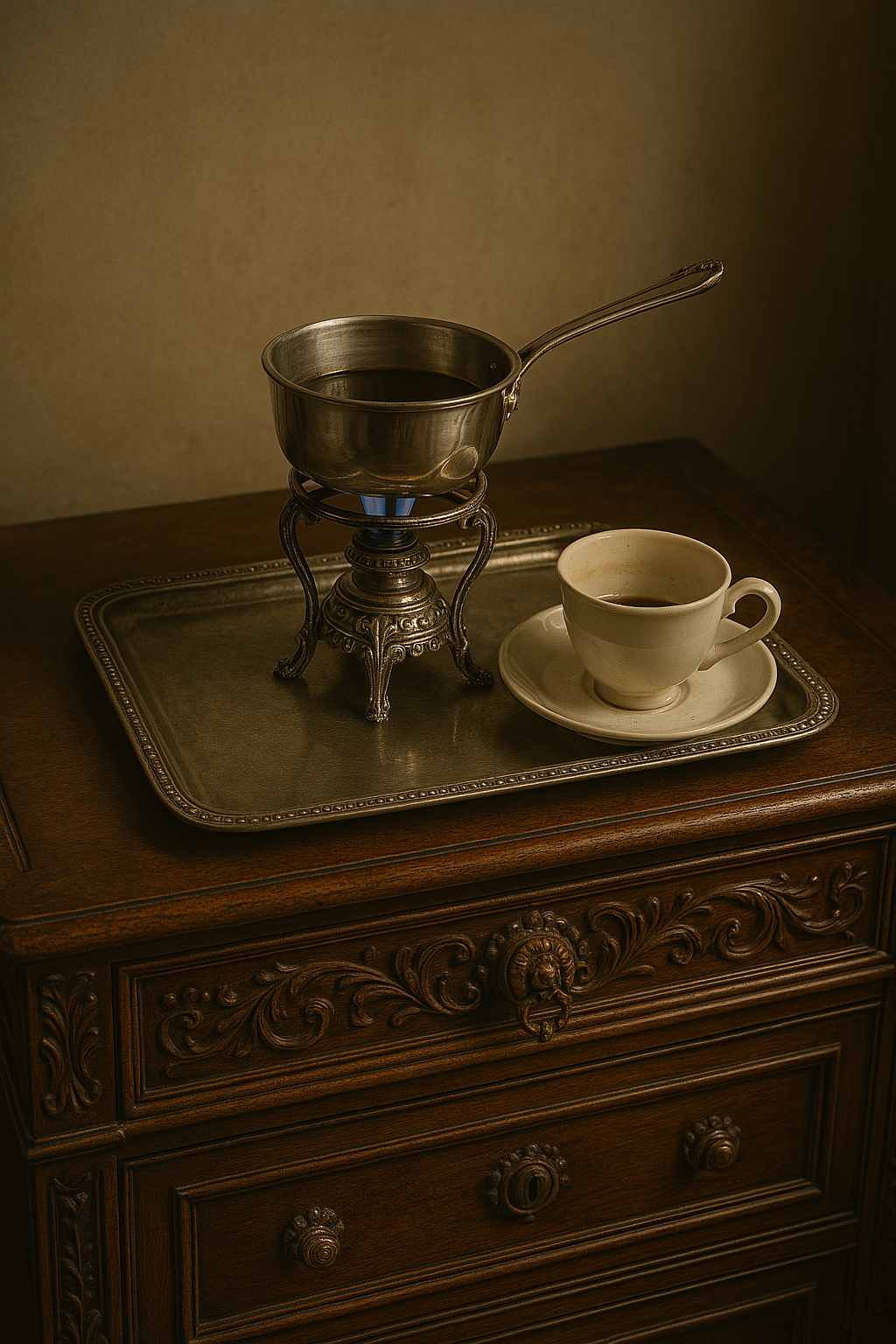
On the chest of drawers there was a tray with a spirit lamp and a small saucepan on it.
A small quantity of a dark fluid remained in the saucepan, and an empty cup and saucer that had been drunk out of stood near it.
I wondered how I could have been so unobservant as to overlook this. Here was a clue worth having.
Poirot delicately dipped his finger into liquid, and tasted it gingerly.He made a grimace.
整理ダンスの上には、アルコールランプと小さな鍋の載ったトレイが置かれていた。
鍋には少量の黒い液体が残っており、そばには、明らかに飲んだ形跡のあるカップとソーサーが置かれていた。
私はなぜこれを見落としていたのかと自分に驚いた。これは明らかに、価値ある手がかりだった。
ポワロはその液体にそっと指先を浸し、慎重に味を見た。そして顔をしかめた。
“Cocoa—with—I think—rum in it.”
「ココアに、たぶんラム酒が入っていたようです」
He passed on to the debris on the floor, where the table by the bed had been overturned.
A reading-lamp, some books, matches, a bunch of keys, and the crushed fragments of a coffee-cup lay scattered about.
彼はそのまま、ベッドのそばでひっくり返されたテーブルの床に散らばった物へと移った。
読書用のランプ、何冊かの本、マッチ、鍵の束、そして粉々に砕けたコーヒーカップの破片が散乱していた。

“Ah, this is curious,” said Poirot.
「これは妙だ」と、ポワロは言った。
“I must confess that I see nothing particularly curious about it.”
「正直言って、別に妙な点はないように見えるけどね」
“You do not?
Observe the lamp—the chimney is broken in two places; they lie there as they fell.
But see, the coffee-cup is absolutely smashed to powder.”
「そうかい?このランプを見てごらん。ガラスのシェード(筒)が二か所で割れているのは、落ちてからそのままになっているからだ。だが見てごらん。コーヒーカップは完全に粉々だ」
“Well,” I said wearily, “I suppose someone must have stepped on it.”
「まあ」と私はうんざりした声で言った。
「誰かが踏んづけたんだろう」
“Exactly,” said Poirot, in an odd voice. “Someone stepped on it.”
「その通りだよ」と、ポワロは妙な口調で言った。
「誰かが踏みつけたんだ」
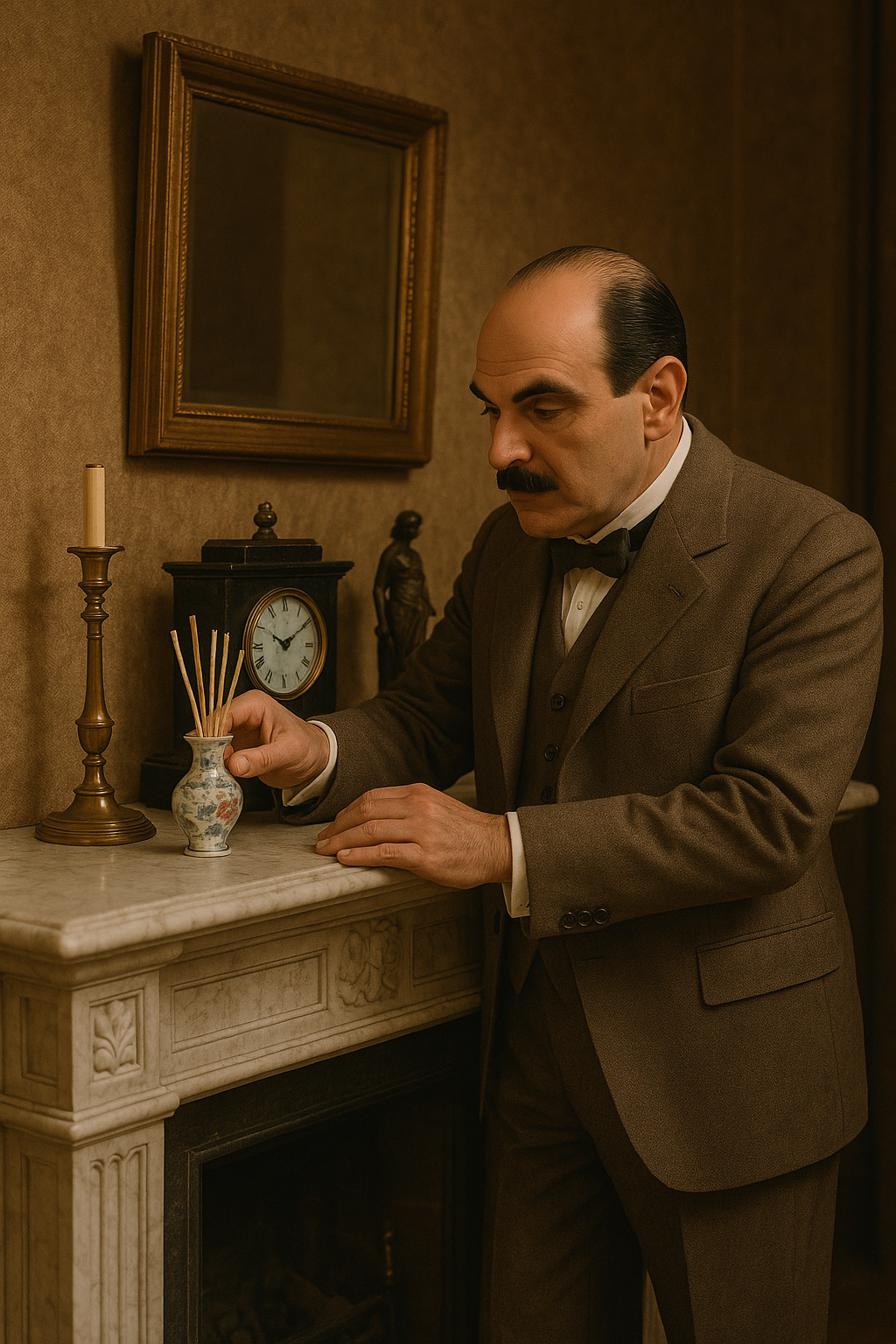
He rose from his knees, and walked slowly across to the mantelpiece, where he stood abstractedly fingering the ornaments, and straightening them—a trick of his when he was agitated.
彼は膝から立ち上がり、ゆっくりとマントルピースのところまで歩いていくと、そこで彼は、置かれた装飾品をいじったり整えたりしていた。彼が動揺している時によく見せる癖だった。
“Mon ami,” he said, turning to me,
“somebody stepped on that cup, grinding it to powder, and the reason they did so was either because it contained strychnine or—which is far more serious—because it did not contain strychnine!”
「モナミ」と、彼は私の方を向いて言った。
「あのカップを踏んで粉々にした人物がいる。その理由は、カップにストリキニーネが入っていたからか、もしくは、もっと重要なのは入っていなかったからだ!」
I made no reply.
I was bewildered, but I knew that it was no good asking him to explain.
In a moment or two he roused himself, and went on with his investigations.
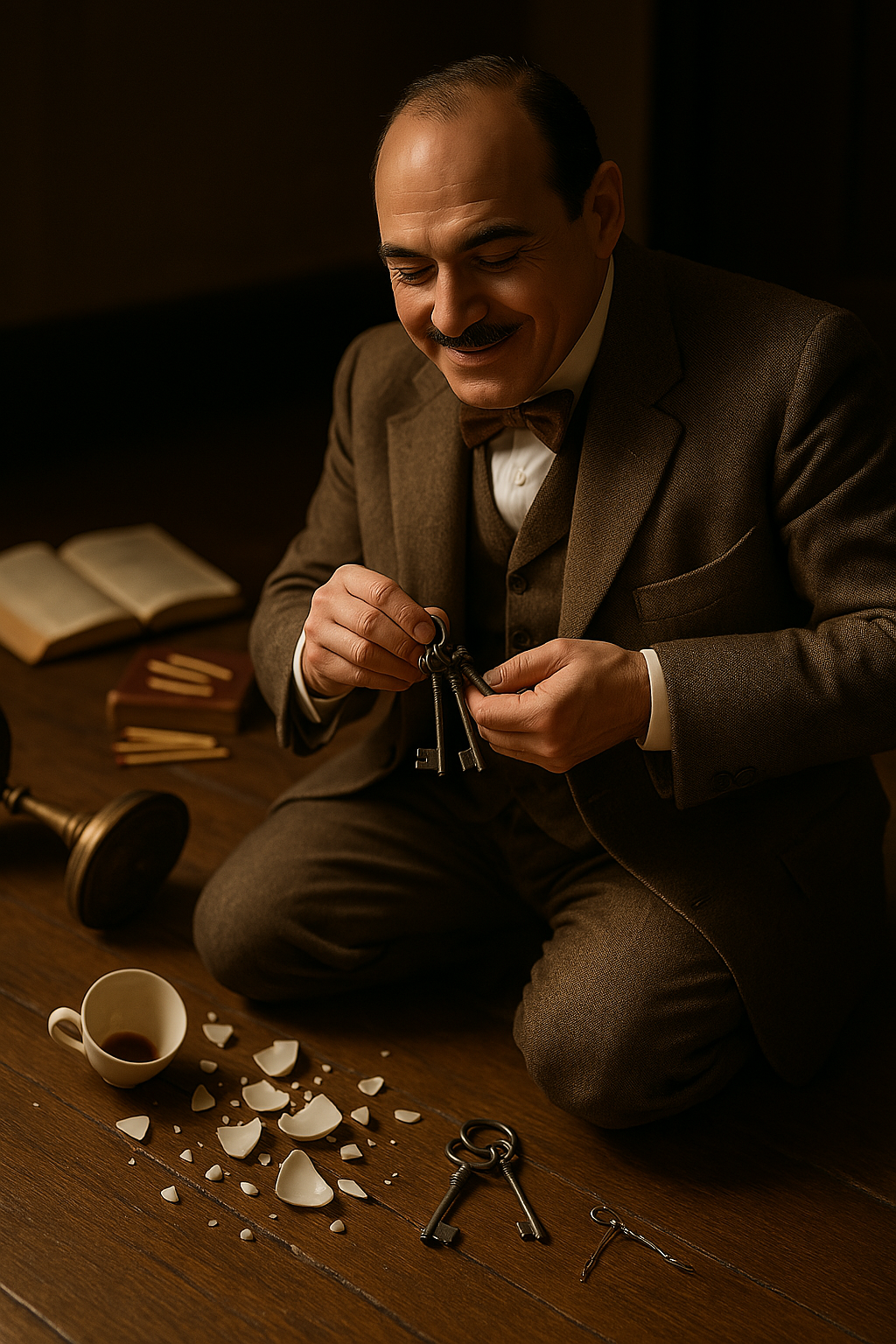
He picked up the bunch of keys from the floor, and twirling them round in his fingers finally selected one, very bright and shining, which he tried in the lock of the purple despatch-case.
It fitted, and he opened the box, but after a moment’s hesitation, closed and relocked it, and slipped the bunch of keys, as well as the key that had originally stood in the lock, into his own pocket.
私は返事をしなかった。
混乱していたが、彼に問いただしても説明は返ってこないことは分かっていた。
数秒後、彼は気を取り直し、調査を再開した。
彼は床から鍵の束を拾い上げ、それを指の間でくるくる回しながら、その中の一本、ひときわ明るく光沢のある鍵を選び、それを紫色の書類カバンの鍵穴に差し込んだ。鍵はぴったり合い、カバンは開いた。
しかし、彼は一瞬ためらったあとにカバンを再び閉じ、鍵をかけ直した。
そしてその鍵の束と、元々鍵穴に刺さっていた鍵の両方を自分のポケットにしまい込んだ。
“I have no authority to go through these papers. But it should be done—at once!”
「私はこれらの書類を調べる権限はありません。しかし、それは今すぐにでもなされるべきことです!」
He then made a very careful examination of the drawers of the wash-stand.
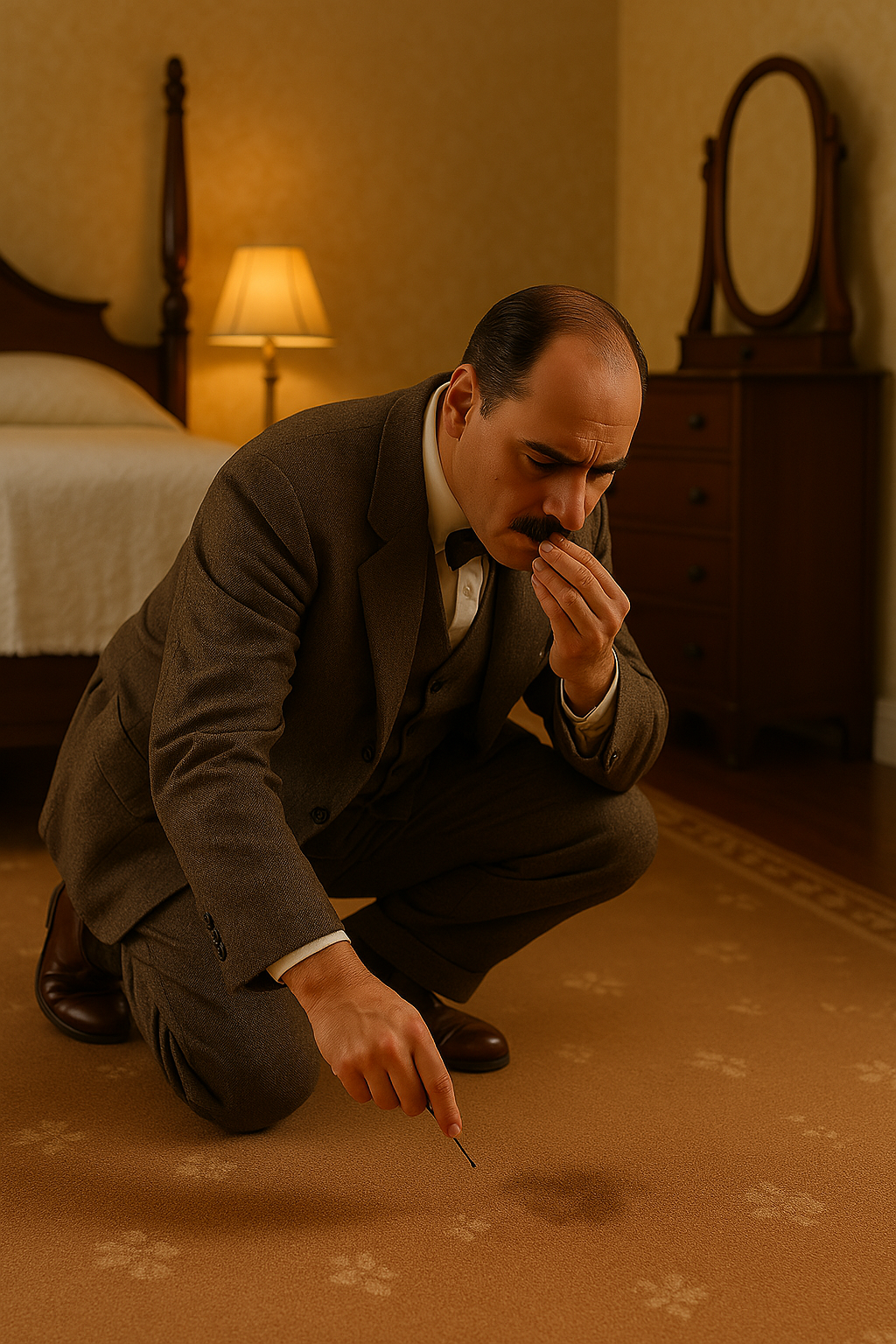
Crossing the room to the left-hand window, a round stain, hardly visible on the dark brown carpet, seemed to interest him particularly.
He went down on his knees, examining it minutely—even going so far as to smell it.
Finally, he poured a few drops of the cocoa into a test tube, sealing it up carefully.
His next proceeding was to take out a little notebook.
そう言って彼は、洗面台の引き出しを非常に丁寧に調べ始めた。
部屋の左手の窓に向かって進むと、暗い茶色のカーペットの上に、ほとんど見えないような丸い染みがあり、それが彼の関心を引いたようだった。
彼は膝をついてその染みを丹念に調べ、匂いをかぐほどであった。
最後に、彼はココアを数滴、試験管に注ぎ、それを慎重に栓をした。
そして次に、小さなノートを取り出して書き込み始めた。
“We have found in this room,” he said, writing busily,
“six points of interest. Shall I enumerate them, or will you?”
「この部屋で我々が見つけたのは」と、彼は忙しく書きながら言った。
「興味深い点が6つある。挙げてみましょうか?それとも、君が?」
“Oh, you,” I replied hastily.
「いや、君がどうぞ」と、私は慌てて答えた。
“Very well, then.
One, a coffee-cup that has been ground into powder;
two, a despatch-case with a key in the lock;
three, a stain on the floor.”
「いいでしょう。では、一つ、粉々に砕かれたコーヒーカップ。二つ、鍵の刺さったままの書類カバン。三つ、床の染み」
“That may have been done some time ago,” I interrupted.
「それは以前からあったものかもしれない」と、私は口を挟んだ。
“No, for it is still perceptibly damp and smells of coffee.
Four, a fragment of some dark green fabric—only a thread or two, but recognizable.”
「いや、まだかすかに湿っていて、コーヒーの匂いがする。四つ、濃い緑色の布地の断片。糸が数本だけだが判別可能だ」
“Ah!” I cried.
“That was what you sealed up in the envelope.”
「ああ!」私は叫んだ。
「それが君が封筒に入れたものだね!」

“Yes. It may turn out to be a piece of one of Mrs. Inglethorp’s own dresses, and quite unimportant. We shall see.
Five, this!”
「そう。これはミセス=イングルソープのドレスの一部かもしれないし、まったく重要でない可能性もある。それは今後わかることだ。五つ目は、これだ!」
With a dramatic gesture, he pointed to a large splash of candle grease on the floor by the writing-table.
彼は大袈裟な身振りで、机のそばの床にある、大きなロウのしみを指さした。
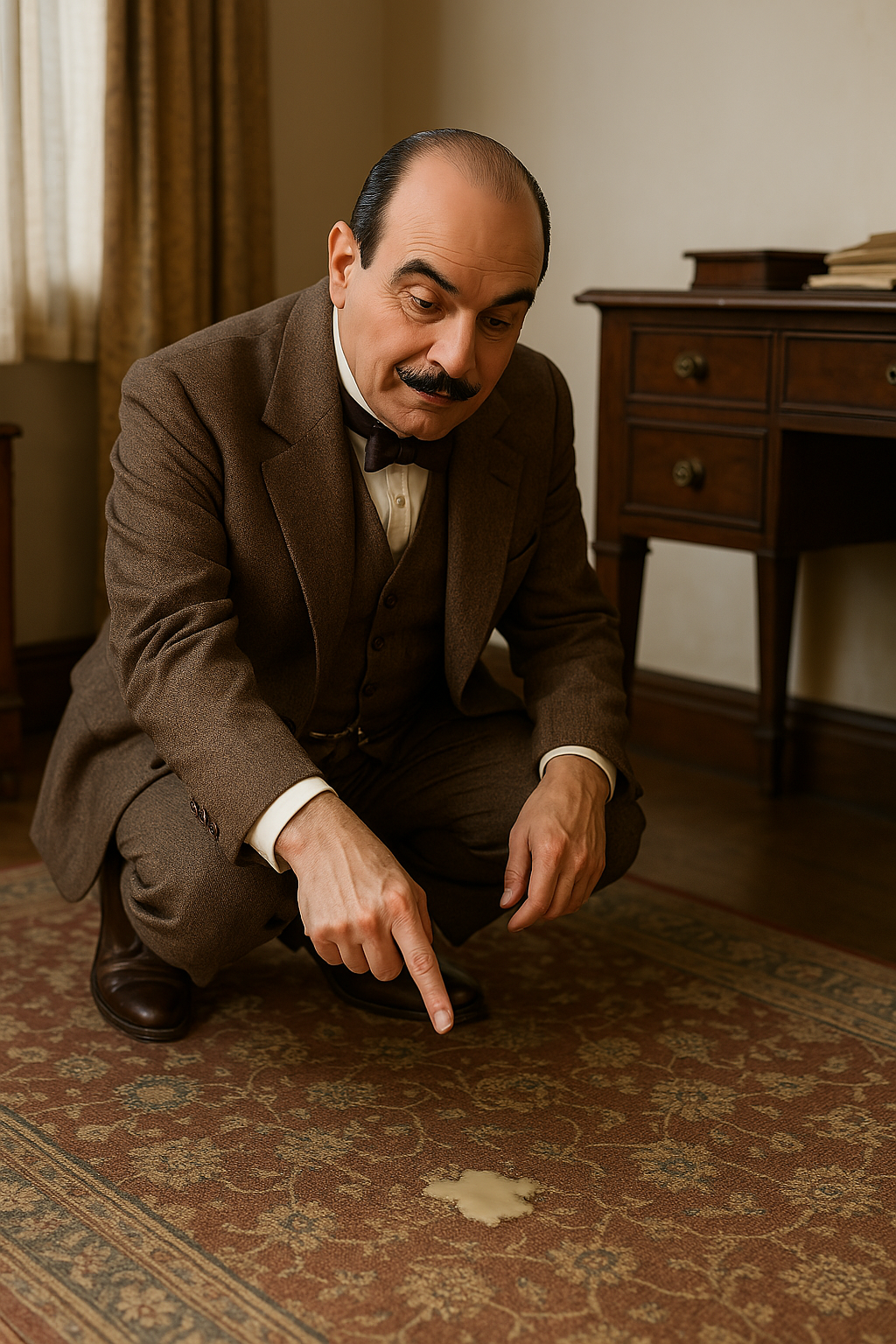
“It must have been done since yesterday, otherwise a good housemaid would have at once removed it with blotting-paper and a hot iron. One of my best hats once—but that is not to the point.”
「これは昨日以降にできたものでなければおかしいんだ。そうでなければ、優秀なメイドが吸い取り紙と温かいアイロンですぐに取り除いていたはずだ。かつて私の最高の帽子の一つが、だが、それは今は関係ない」
“It was very likely done last night.
We were very agitated.
Or perhaps Mrs. Inglethorp herself dropped her candle.”
「昨夜できたものかもしれないな。私たちはすごく動揺していたし。あるいは、ミセス=イングルソープ自身がロウソクを落としたのかもしれないが」
“You brought only one candle into the room?”
「ロウソクは、部屋に一本だけ持ってきたのかい?」
“Yes. Lawrence Cavendish was carrying it. But he was very upset.
He seemed to see something over here”—I indicated the mantelpiece—“that absolutely paralysed him.”
「そうだね。ローレンス=キャヴンディッシュが持ってた。でも、彼はかなり動揺しててね。こっちを見てたようだ」
—I indicated the mantelpiece—
私はマントルピースの方に顔を向けた。
“that absolutely paralysed him.”
「なんだか固まってたよ」
“That is interesting,” said Poirot quickly.
“Yes, it is suggestive”
「ほう、それは面白いですな」と、ポワロがすぐさま反応した。
「うん、それはちょっと意味がありそうだ」
—his eye sweeping the whole length of the wall—
そう言って壁の方をずっと見渡していた。
“but it was not his candle that made this great patch, for you perceive that this is white grease;
whereas Monsieur Lawrence’s candle, which is still on the dressing-table, is pink.
On the other hand, Mrs. Inglethorp had no candlestick in the room, only a reading-lamp.”
「でもね、この大きなロウのシミを作ったのは彼のロウソクじゃない。見てごらん。これは白いロウでしょ?
一方で、ムッシュ=ローレンスのロウソクは今もドレッサーの上にあるけどピンク色だ。それに、ミセス=イングルソープの部屋にはロウソク立てなんてなくて、読書ランプだけだったんだ」
“Then,” I said, “what do you deduce?”
「とすると」と、私は言った。
「君はどう推理するんだい?」
To which my friend only made a rather irritating reply, urging me to use my own natural faculties.
それに対してポワロは、君自身の観察力を使うよう私にすすめ、ちょっと人をイラっとさせる返事をよこしただけだった。
“And the sixth point?” I asked.
“I suppose it is the sample of cocoa.”
「それで、六つ目の手がかりってやつは?」と、私は尋ねた。
「てっきりココアのサンプルかと思ってたけど」
“No,” said Poirot thoughtfully.
“I might have included that in the six, but I did not. No, the sixth point I will keep to myself for the present.”
「いや」と、ポワロは考え込むように言った。
「それも六つの中に入れようかとも思ったけど、やめたんだ。六つ目はね、今はまだ内緒だよ」
He looked quickly round the room.
そう言ってから、彼は部屋の中を素早く見回した。
“There is nothing more to be done here, I think, unless”
「もうここでできることはないかな。いや、待てよ」
—he stared earnestly and long at the dead ashes in the grate.
彼の目が暖炉の灰にじっと注がれた。
“The fire burns—and it destroys. But by chance—there might be—let us see!”
「火というものはね。燃やし、そしてすべてを消してしまう。けれど、運が良ければ、何かが残っているかもしれん。ちょっと調べてみよう」
Deftly, on hands and knees, he began to sort the ashes from the grate into the fender, handling them with the greatest caution.
そう言うやいなや、ポワロはひざをついて、慎重に灰をフェンダー(暖炉の前の格子状の囲い)にかき出し始めた。まるで骨董品を扱うみたいに、細心の注意を払っている。
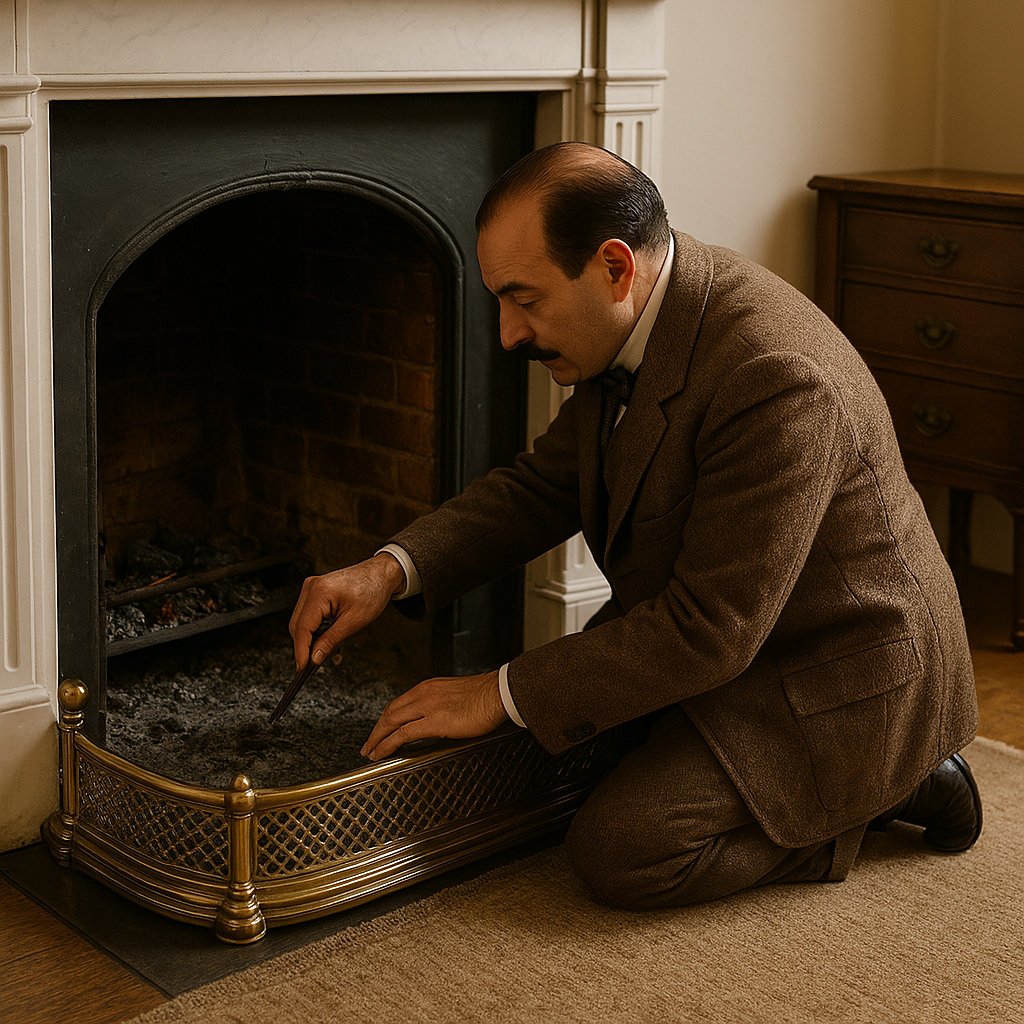
Suddenly, he gave a faint exclamation.
すると突然、小さな声で叫んだ。
“The forceps, Hastings!”
「ヘイスティングス、ピンセットを!」
I quickly handed them to him, and with skill he extracted a small piece of half charred paper.
私はすぐさま彼に手渡した。ポワロは器用にそれを使って、焦げかけた小さな紙切れをつまみ出した。
“There, mon ami!” he cried.
“What do you think of that?”
「どうだね、モナミ!」と、彼は嬉しそうに言った。
「これ、君は何だと思う?」
I scrutinized the fragment.
This is an exact reproduction of it:—
私はその紙をじっと見つめた。
これが、その正確に再現したものである。
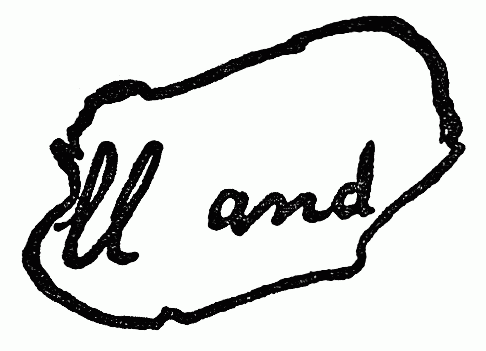
I was puzzled. It was unusually thick, quite unlike ordinary notepaper. Suddenly an idea struck me.
僕は首をひねった。その紙切れは妙に厚手で、普通の便箋とはまったく違っていた。
すると、突然ひらめいた。
“Poirot!” I cried.
“This is a fragment of a will!”
「ポワロ!」と私は叫んだ。
「これ、遺言書の切れ端じゃないか!」
“Exactly.”
「その通りだよ」
I looked up at him sharply.
私は彼を鋭く見上げた。
“You are not surprised?”
「驚かないのか?」
“No,” he said gravely, “I expected it.”
「まあね」と、ポワロは真面目な顔で答えた。
「そうだと思っていたよ」
I relinquished the piece of paper, and watched him put it away in his case, with the same methodical care that he bestowed on everything.
My brain was in a whirl. What was this complication of a will?
Who had destroyed it?
The person who had left the candle grease on the floor?
Obviously.
But how had anyone gained admission?
All the doors had been bolted on the inside.
私は紙切れを手放し、それを彼が例のごとく几帳面にケースへしまうのを見守った。ポワロは、何事にも同じように几帳面なのだ。
私の頭の中はぐるぐると渦を巻いていた。遺言書が関係しているなんて、どういうことだ?
誰が破いたんだ?
床にロウをこぼした人物?
たぶんそうだ。
でも、そもそも誰が部屋に入れたというんだ?すべての扉は内側からカンヌキがかかっていたじゃないか。
“Now, my friend,” said Poirot briskly, “we will go. I should like to ask a few questions of the parlourmaid—Dorcas, her name is, is it not?”
「さて、ヘイスティングス」と、ポワロがてきぱきと言った。
「引き上げよう。使用人のドーカスにちょっと話を聞きたい。名前はドーカスであってるよね?」
We passed through Alfred Inglethorp’s room, and Poirot delayed long enough to make a brief but fairly comprehensive examination of it.
We went out through that door, locking both it and that of Mrs. Inglethorp’s room as before.
I took him down to the boudoir which he had expressed a wish to see, and went myself in search of Dorcas.
When I returned with her, however, the boudoir was empty.
私たちはアルフレッド=イングルソープの部屋を通って行ったのだが、ポワロはそこで足を止め、手短に、けれどきちんとした調査を行った。
それから、ミセス=イングルソープの部屋とあわせて、両方のドアに再び鍵をかけてそこを出た。
ポワロが見たいと言うので、私は一階のミセス=イングルソープの書斎に案内し、ドーカスを探しに出た。そして彼女を連れて戻ってみると、書斎には誰もいなかった。
“Poirot,” I cried,“where are you?”
「ポワロ!」と私は呼んだ。
「どこだい?」
“I am here, my friend.”
「ここだよ、きみ」
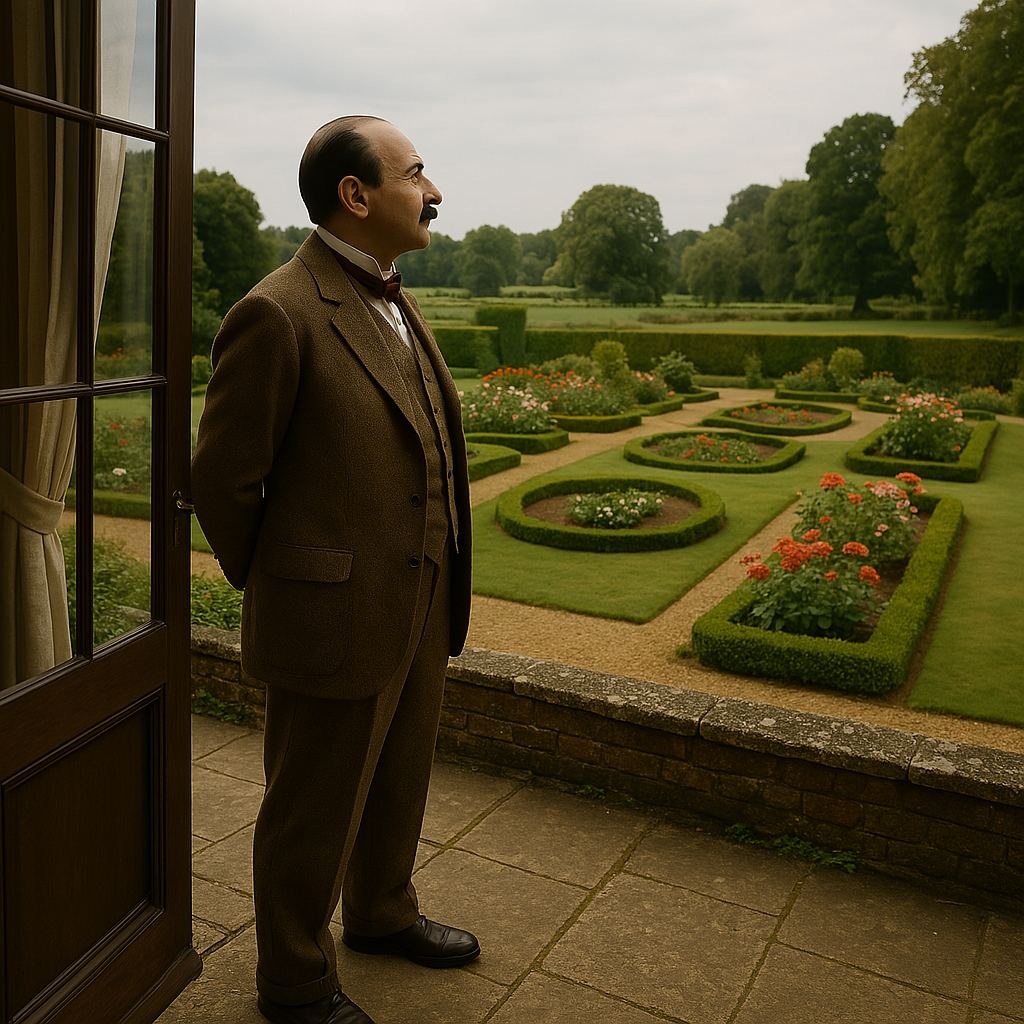
He had stepped outside the French window, and was standing, apparently lost in admiration, before the various shaped flower beds.
ポワロはフランス窓から、外に出ていて、さまざまな形をした花壇を眺めながら、まるで、見惚れているかのように、立っていた。
“Admirable!” he murmured.
“Admirable! What symmetry! Observe that crescent; and those diamonds—their neatness rejoices the eye. The spacing of the plants, also, is perfect. It has been recently done; is it not so?”
「見事だ!」と、彼はつぶやいた。
「実に見事!この対称性!あの三日月形を見たまえ。そして、あの菱形。なんという整然とした配置だ。見る者の目を喜ばせるね。植物の間隔も完璧だ。最近、手入れされたばかりだろう?」
“Yes, I believe they were at it yesterday afternoon. But come in—Dorcas is here.”
「そうだと思うよ。たしか、昨日の午後、庭師が手入れしてたはずだ。でも、さあ中に入ろう。ドーカスが来てる」
“Eh bien, eh bien! Do not grudge me a moment’s satisfaction of the eye.”
「エビヤン(まあまあ)!少しくらい、この美しさに心を和ませたってバチは当たらんよ」
“Yes, but this affair is more important.”
「ああ、だけど、今は事件の方が大事だろ」
“And how do you know that these fine begonias are not of equal importance?”
「では君は、この見事なベゴニアたちが、同じくらい重要じゃないってどうしてわかるんだい?」
I shrugged my shoulders.
There was really no arguing with him if he chose to take that line.
私は肩をすくめた。
ポワロがそういう調子で来られると、もう言い返してもムダなのだ。
“You do not agree? But such things have been. Well, we will come in and interview the brave Dorcas.”
「納得いかんかね?でもね、過去にはこういうささいなものが、決定的な意味を持ったこともあるんだよ。さて、では、中に入って、勇敢なるドーカスに話を聞こうか」
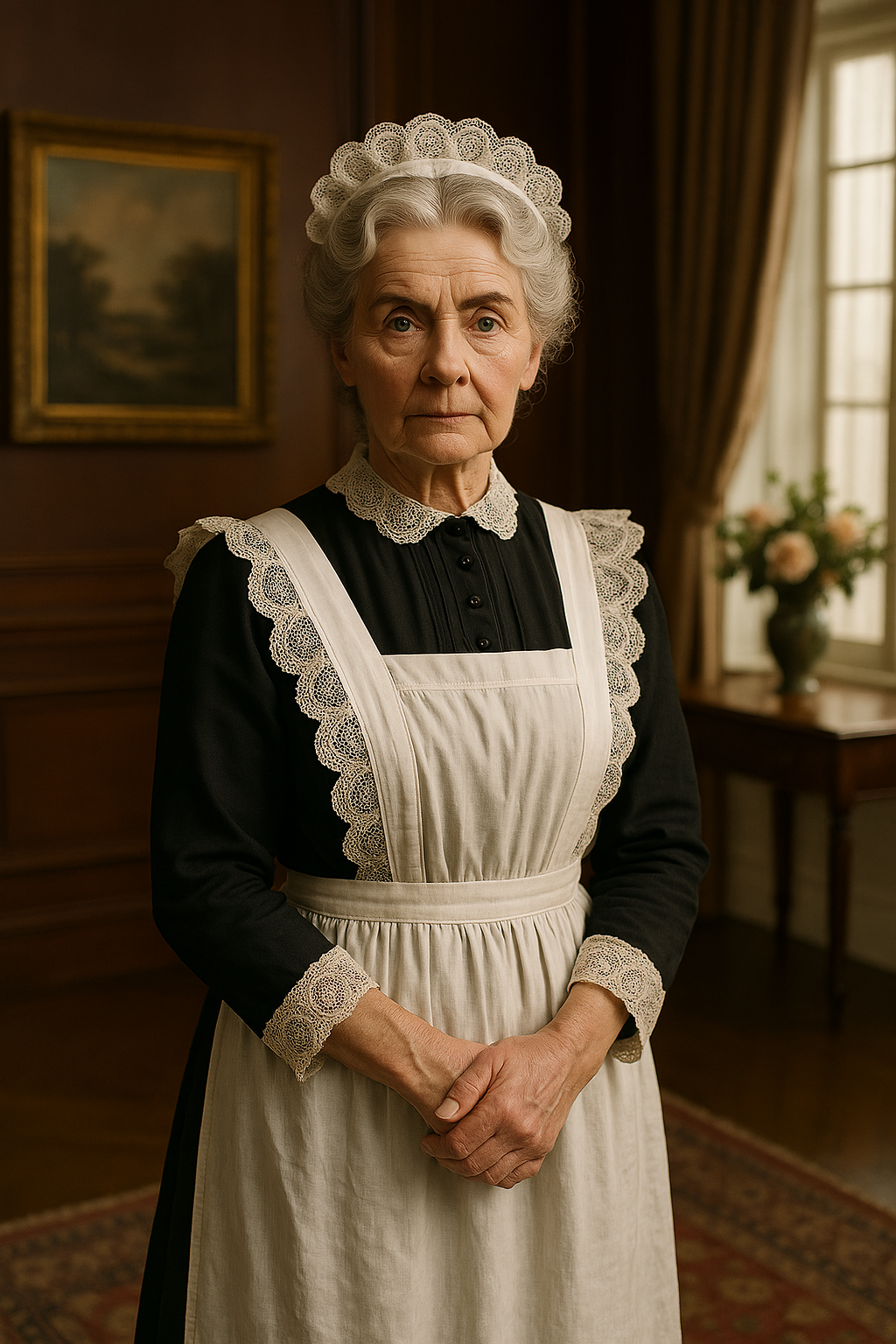
Dorcas was standing in the boudoir, her hands folded in front of her, and her grey hair rose in stiff waves under her white cap.
She was the very model and picture of a good old-fashioned servant.
In her attitude towards Poirot, she was inclined to be suspicious, but he soon broke down her defences.
He drew forward a chair.
ドーカスは書斎に立って、両手を前でしっかりと組み、白いキャップの下からは、しっかりとセットされた灰色の髪が波打っていた。
まさに、古き良き時代の理想的な女中そのものといった風貌だった。
彼女は最初、ポワロに対してどこか警戒心を抱いているようだったが、ポワロの話術の前に、そのガードはすぐに崩れた。
ポワロは椅子を引いて彼女に勧めた。
“Pray be seated, mademoiselle.”
「どうぞ、おかけください、マドモワゼル」

“Thank you, sir.”
「ありがとうございます、旦那様」
“You have been with your mistress many years, is it not so?”
「あなたは奥さまと長いこと一緒にいらっしゃったとか?」

“Ten years, sir.”
「ええ、もう十年になります、旦那様」
“That is a long time, and very faithful service. You were much attached to her, were you not?”
「それは長い。忠実なご奉公でしたね。奥さまにはとても思い入れがあったんでしょう?」
“She was a very good mistress to me, sir.”
「はい。とても良い奥さまでしたから」
“Then you will not object to answering a few questions. I put them to you with Mr. Cavendish’s full approval.”
「では、いくつか質問してもよろしいですね。これは、ミスター=キャヴンディッシュの許可を得てのことですから、安心してください」
“Oh, certainly, sir.”
「もちろんです、旦那様」
“Then I will begin by asking you about the events of yesterday afternoon. Your mistress had a quarrel?”
「では、まず昨日の午後のことを伺いましょう。奥さまは誰かと口論していらっしゃいましたね?」
“Yes, sir. But I don’t know that I ought——”
「はい、そうです。でも、それをお話していいのか」
Dorcas hesitated.
ドーカスは少し口ごもった。
Poirot looked at her keenly.
ポワロはその様子を鋭いまなざしでじっと見つめた。
“My good Dorcas, it is necessary that I should know every detail of that quarrel as fully as possible.
Do not think that you are betraying your mistress’s secrets.
Your mistress lies dead, and it is necessary that we should know all—if we are to avenge her.
Nothing can bring her back to life, but we do hope, if there has been foul play, to bring the murderer to justice.”
「いいですか、ドーカス。その口論について、できるだけ詳しく話してもらわなくてはならないのです。それは奥さまの秘密を洩らすという風には考えてはいけません。
奥さまは、もうこの世にはいらっしゃらない。そして、私たちが奥さまのかたきを討つためには、全てのことを知る必要があるのです。
もう奥さまは帰っては来られませんが、もし犯罪行為があったのであれば、その犯罪者に正義の裁きを受けさせたいじゃないですか」
“Amen to that,” said Dorcas fiercely.
“And, naming no names, there’s one in this house that none of us could ever abide! And an ill day it was when first he darkened the threshold.”
「ああ、そうですとも」と、ドーカスは強く言った。
「名前は出しませんけど、この家には、私たち誰もが我慢することのできない方が一人います! あの人がこの家の敷居をまたいだ日から、ろくなことがありませんでした!」
Poirot waited for her indignation to subside, and then, resuming his business-like tone, he asked:
ポワロは、彼女の怒りが静まるのを待ってから、事務的に落ち着いた口調で続けた。
“Now, as to this quarrel? What is the first you heard of it?”
「では、その口論についてですが、最初に気づいたのはいつですか?」
“Well, sir, I happened to be going along the hall outside yesterday——”
「はい、旦那様。たしか昨日のことでした。ちょうど廊下を通っていたときに」
“What time was that?”
「それは何時ごろでしたか?」
“I couldn’t say exactly, sir, but it wasn’t tea-time by a long way. Perhaps four o’clock—or it may have been a bit later.
Well, sir, as I said, I happened to be passing along, when I heard voices very loud and angry in here.
I didn’t exactly mean to listen, but—well, there it is. I stopped.
The door was shut, but the mistress was speaking very sharp and clear, and I heard what she said quite plainly.
‘You have lied to me, and deceived me,’ she said.
I didn’t hear what Mr. Inglethorp replied.
He spoke a good bit lower than she did—but she answered:
‘How dare you? I have kept you and clothed you and fed you! You owe everything to me! And this is how you repay me! By bringing disgrace upon our name!’
Again I didn’t hear what he said, but she went on:
‘Nothing that you can say will make any difference. I see my duty clearly. My mind is made up. You need not think that any fear of publicity, or scandal between husband and wife will deter me.’
Then I thought I heard them coming out, so I went off quickly.”
「正確には申し上げられませんが、お茶の時間にはまだ早うございました。たぶん4時か、それよりちょっとあとだったかと。
それで、旦那様。ちょうどそのとき廊下を通りかかったら、この部屋から怒鳴り声が聞こえてきたんです。
ええ、まあ、わざわざ聞くつもりじゃなかったんですけど。その、ちょっと足が止まってしまいまして。
扉は閉まってましたけど、奥様の声ははっきりと聞こえました。
『あなたは私に嘘をついて、裏切ったのよ!』って。
それで、ミスター=イングルソープが何か言っておられたんですが、奥様よりずっと声がちいさくて聞き取れませんでした。でも、奥様はこう続けられました。
『よくもそんなことができたわね!私はあなたを養って、服を着せて、食べさせてきたのよ!あなたはすべてを私に負ってるのよ!なのに、こんな仕打ちをするなんて!私たちの家の名を汚すなんて!』
また旦那様が何か言われましたが、それも聞こえないうちに、奥様は続けられました。
『何を言おうと無駄ですよ。私は自分のなすべきことは分かってます。もう決めました。世間に騒がれるとか、夫婦間のスキャンダルだとか、そんなことで私の決意は変わりません。』
それから、誰かが出てくる気配がしたので、私はすぐその場を離れました」
“You are sure it was Mr. Inglethorp’s voice you heard?”
「その声がミスター=イングルソープだったのは間違いないんですか?」
“Oh, yes, sir, whose else’s could it be?”
「ええ、もちろんですとも、旦那様。他に誰がいるっていうんです?」
“Well, what happened next?”
「それで、その後はどうなりました?」
“Later, I came back to the hall; but it was all quiet.
At five o’clock, Mrs. Inglethorp rang the bell and told me to bring her a cup of tea—nothing to eat—to the boudoir.
She was looking dreadful—so white and upset.
‘Dorcas,’ she says,‘I’ve had a great shock.’ ‘I’m sorry for that, m’m,’
I says. ‘You’ll feel better after a nice hot cup of tea, m’m.’
She had something in her hand. I don’t know if it was a letter, or just a piece of paper, but it had writing on it, and she kept staring at it, almost as if she couldn’t believe what was written there.
She whispered to herself, as though she had forgotten I was there:
‘These few words—and everything’s changed.’
And then she says to me:
‘Never trust a man, Dorcas, they’re not worth it!’
I hurried off, and got her a good strong cup of tea, and she thanked me, and said she’d feel better when she’d drunk it.
‘I don’t know what to do,’ she says.
‘Scandal between husband and wife is a dreadful thing, Dorcas. I’d rather hush it up if I could.’
Mrs. Cavendish came in just then, so she didn’t say any more.”
「そのあと、また廊下に戻ってきたんですけど、そのときはもう静かでした。
午後5時ごろ、奥様がベルを鳴らされて、お茶を書斎に持ってくるように、食べ物はいらないと言われました。
奥様、ひどい顔色でした。真っ白で、すごく取り乱しておられて。
奥様が言われたんです。
『ドーカス、大きなショックを受けたのよ』って。
私は『それはお気の毒に、奥様』と、申し上げました。『熱いお茶を飲めば、きっと少しは気が晴れますよ』って。
奥様は何かを手に持っておられました。手紙か、ただの紙切れかは分かりませんが、何か書いてあって、それをじっと見つめておられて、まるで書かれていることが信じられない、というようなご様子でした。
それで、私がいることも忘れておられるのか、小さな声でつぶやかれたんです。『たった数行で、すべてが変わってしまったわ』って。
それからまた私に向かって言われました。
『男なんて信用しちゃだめよ、ドーカス。あの人たちなんか、ろくなもんじゃないわ!』
私は慌てて台所に戻って、しっかり濃いめに淹れたお茶を持って行きました。
奥様はお礼を言われて、『これを飲んだら少し気分が楽になるわ』とおっしゃってました。
それから続けて、『どうしたらいいかわからないわ。夫婦間のスキャンダルって、ほんとに恐ろしいことよ、ドーカス。できればなかったことにしたいのよ』って。
ちょうどそのとき、ミセス=キャヴンディッシュが入ってこられて、それ以上は何もおっしゃいませんでした」
“She still had the letter, or whatever it was, in her hand?”
「そのとき、まだ奥様はその手紙か何かを持っておられたんですね?」
“Yes, sir.”
「ええ、旦那様」
“What would she be likely to do with it afterwards?”
「その後、それをどうされたと思いますか?」
“Well, I don’t know, sir, I expect she would lock it up in that purple case of hers.”
「さあ、旦那様。たぶんいつもの紫のカバンにしまわれたんじゃないかと」
“Is that where she usually kept important papers?”
「奥様は、普段から大事な書類をそこに入れておられたんですね?」
“Yes, sir. She brought it down with her every morning, and took it up every night.”
「そうです、旦那様。奥様は毎朝それを下の書斎に持って降りて、夜になるとまたご自分の寝室に持って上がっておられました」
“When did she lose the key of it?”
「その鍵をなくされたのはいつですか?」
“She missed it yesterday at lunch-time, sir, and told me to look carefully for it.
She was very much put out about it.”
「昨日のお昼時に見当たらないとおっしゃって、私にもよく探すように言いつけられました。奥様、とても気を揉んでおられました」
“But she had a duplicate key?”
「でも、予備の鍵があったんですね?」
“Oh, yes, sir.”
「はい、旦那様」
Dorcas was looking very curiously at him and, to tell the truth, so was I.
What was all this about a lost key?
Poirot smiled.
ドーカスはポワロがなぜ知っているのか、不思議そうな顔をして彼を見ていた。カギをなくしたとはいったい何のことなのか?
ポワロはにっこりと笑った。
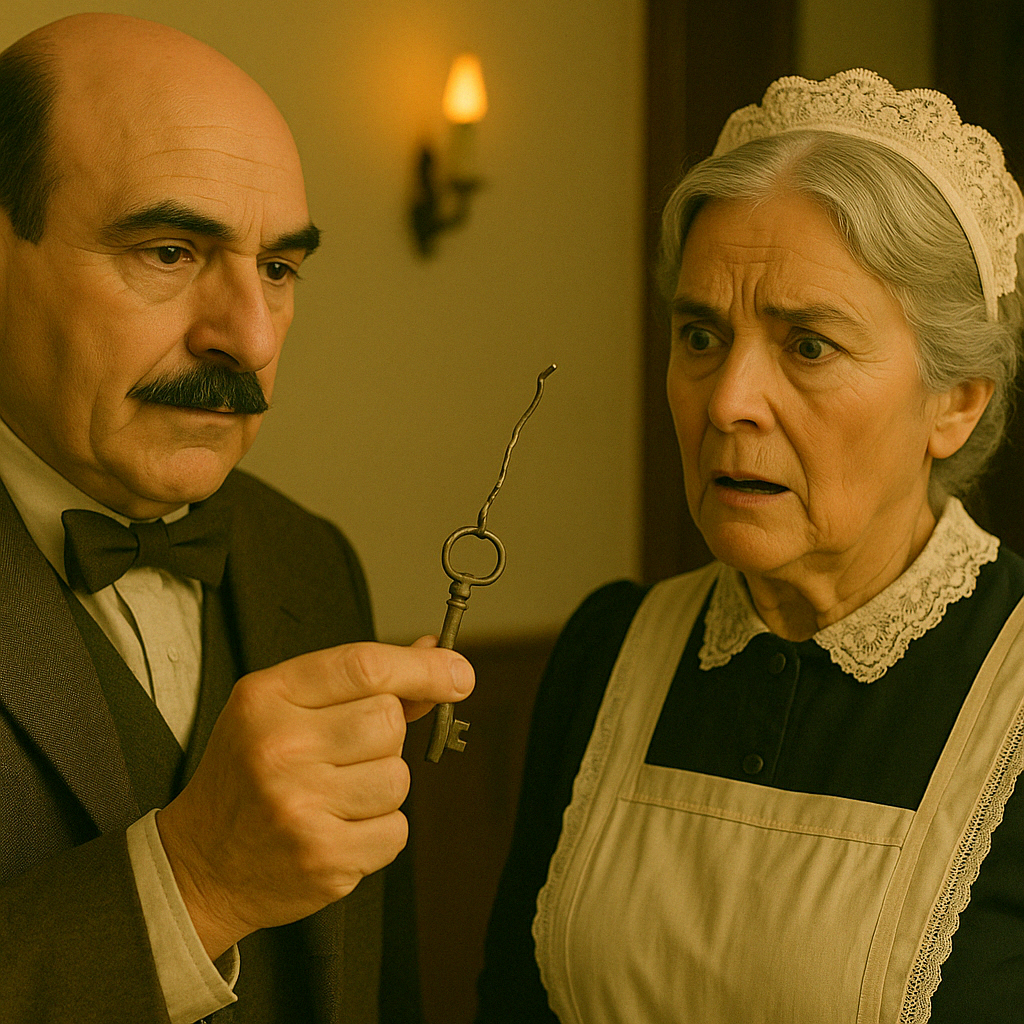
“Never mind, Dorcas, it is my business to know things. Is this the key that was lost?”
「気にしなくていいですよ、ドーカス。私は、いろんなことを知っているのが仕事ですから。これがその失くされた鍵でしょう?」
He drew from his pocket the key that he had found in the lock of the despatch-case upstairs.
Dorcas’s eyes looked as though they would pop out of her head.
彼はポケットから、あの書類カバンに付いていた鍵を取り出して見せた。
ドーカスの目はまるで頭から飛び出してくるかのようだった。
“That’s it, sir, right enough. But where did you find it? I looked everywhere for it.”
「あ、それです。それに間違いありません、旦那様!でも、どこで見つけられたんです?私、あらゆる場所を探したんですよ!」
“Ah, but you see it was not in the same place yesterday as it was to-day.
Now, to pass to another subject, had your mistress a dark green dress in her wardrobe?”
「昨日と今日では、鍵は同じ場所になかったんですよ。さて、話を変えましょう。奥様のクローゼットに濃い緑のドレスはありましたか?」
Dorcas was rather startled by the unexpected question.
ドーカスは、思いもよらない質問にちょっと驚いたようだった。
“No, sir.”
「いいえ、旦那様」
“Are you quite sure?”
「間違いありませんか?」
“Oh, yes, sir.”
「ええ、間違いありません」
“Has anyone else in the house got a green dress?”
「この家の他の誰かで、緑のドレスを持っている人はいますか?」
Dorcas reflected.
ドーカスは少し考え込んだ。
“Miss Cynthia has a green evening dress.”
「ミス=シンシアが緑のイブニングドレスをお持ちです」
“Light or dark green?”
「明るい緑?それとも濃い緑?」
“A light green, sir; a sort of chiffon, they call it.”
「明るい緑です、旦那様。シフォンとかいう素材で呼ばれているものです」
“Ah, that is not what I want. And nobody else has anything green?”
「ああ、それは探しているものではないな。他に緑のものを持ってる人は誰もいませんか?」
“No, sir—not that I know of.”
「はい、旦那様。私の知る限りでは」
Poirot’s face did not betray a trace of whether he was disappointed or otherwise. He merely remarked:
ポワロの顔には、がっかりしたのかどうかも分からないほど無表情だった。ただ淡々とこう言った。
“Good, we will leave that and pass on.
Have you any reason to believe that your mistress was likely to take a sleeping powder last night?”
「いいでしょう、それは一旦脇に置いておきましょう。では次に、奥様が昨夜、睡眠薬を飲む予定だったということに何か心当たりはありますか?」
“Not last night, sir, I know she didn’t.”
「いいえ、昨夜は絶対にありません、旦那様。私にはわかっております」
“Why do you know so positively?”
「なぜそんなに断言できるのですか?」
“Because the box was empty.
She took the last one two days ago, and she didn’t have any more made up.”
「箱が空だったからです。最後の一包は一昨日使われてしまって、それ以来、新しく処方もされておられませんので」
“You are quite sure of that?”
「それは確かなんですね?」
“Positive, sir.”
「はい、確かです、旦那様」
“Then that is cleared up! By the way, your mistress didn’t ask you to sign any paper yesterday?”
「よろしい、その件は解決しました!
ところで、奥様は昨日、あなたに何か書類にサインを頼んだりしていませんか?」
“To sign a paper? No, sir.”
「書類にサインですか?いえ、まったくそんなことは」
“When Mr. Hastings and Mr. Lawrence came in yesterday evening, they found your mistress busy writing letters.
I suppose you can give me no idea to whom these letters were addressed?”
「昨日の夕方、ミスタ=ヘイスティングスとミスタ=ローレンスが帰ってきたとき、奥様は手紙を書いていたそうです。
その手紙は誰宛てだったか、心当たりがあれば教えていただきたいのですが?」
“I’m afraid I couldn’t, sir. I was out in the evening. Perhaps Annie could tell you, though she’s a careless girl. Never cleared the coffee-cups away last night. That’s what happens when I’m not here to look after things.”
「申し訳ないですが、存じ上げません、旦那様。私、昨日の夕方は外出しておりまして。もしかしたら<アニー>なら知ってるかもしれませが、あの子はちょっといい加減なところがあって。
昨夜も、コーヒーカップを全然片付けずにそのままにしてて。私が最後まで見ていないとこうなんです」
Poirot lifted his hand.
ポワロは手を軽く上げて制した。
“Since they have been left, Dorcas, leave them a little longer, I pray you. I should like to examine them.”
「片づけていなければ、ドーカス。もう少しの間、そのままにしておいていただけませんか。そのコーヒーカップを調べたいんです」
“Very well, sir.”
「かしこまりました、旦那様」
“What time did you go out last evening?”
「昨晩、あなたが外出されたのは何時でしたか?」
“About six o’clock, sir.”
「6時ごろです、旦那様」
“Thank you, Dorcas, that is all I have to ask you.”
「ありがとう、ドーカス。もう聞きたいことは以上です」
He rose and strolled to the window.
ポワロはそう言って立ち上がり、窓辺へと歩いていった。
“I have been admiring these flower beds. How many gardeners are employed here, by the way?”
「いやあ、この花壇は実に見事ですね。ところで、今こちらには庭師は何人いらっしゃるんです?」
“Only three now, sir.
Five, we had, before the war, when it was kept as a gentleman’s place should be.
I wish you could have seen it then, sir.
A fair sight it was.
But now there’s only old Manning, and young William, and a new-fashioned woman gardener in breeches and such-like.
Ah, these are dreadful times!”
「今は、三人だけです、旦那様。戦争前は五人いたんですよ。あの頃は、紳士階級のお屋敷にふさわしく、きちんと整えられていて、旦那様にも、ぜひ一度、あの頃の姿を見ていただければ。それはそれは、見事なお庭だったんです。今じゃ、年寄りのマニングと、若いウィリアム、それに最近入ったズボン姿の今どきの女庭師だけですよ。ほんと、世も末ですね」
“The good times will come again, Dorcas. At least, we hope so. Now, will you send Annie to me here?”
「また良い時代が来ますよ、ドーカス。少なくとも、私たちはそう願っています。さて、アニーをここに呼んでもらえますか?」
“Yes, sir. Thank you, sir.”
「かしこまりました。では、失礼いたします、旦那様」
“How did you know that Mrs. Inglethorp took sleeping powders?”
「ポワロ、どうしてミセス=イングルソープが睡眠薬を使っていたって分かったんだい?」
I asked, in lively curiosity, as Dorcas left the room.
ドーカスが部屋を出ていくと、私は興味津々でポワロに尋ねた。
“And about the lost key and the duplicate?”
「それに、鍵をなくした話や、予備の鍵のことまで?」
“One thing at a time. As to the sleeping powders, I knew by this.”
「ひとつずつにしよう。睡眠薬の件は、これで知ったんだ」
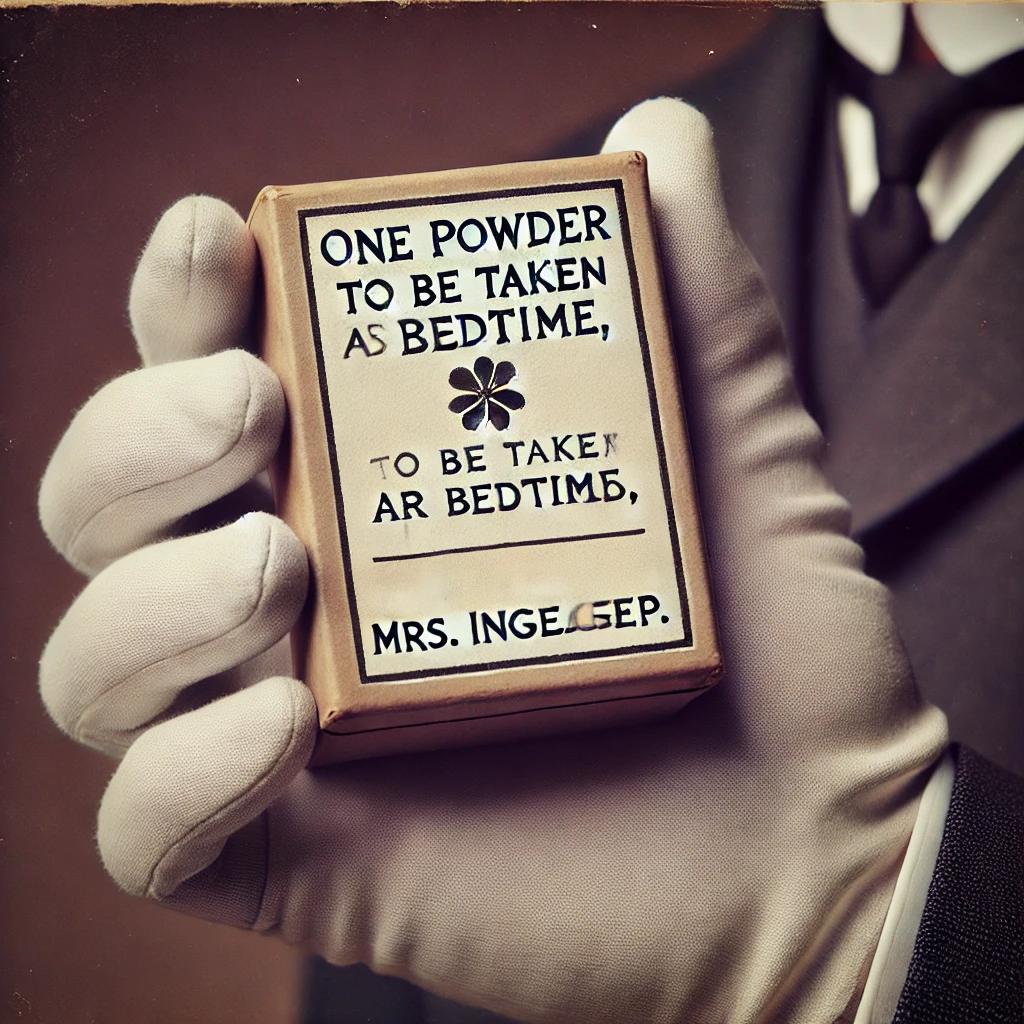
He suddenly produced a small cardboard box, such as chemists use for powders.
ポワロは突然、小さな紙の箱を取り出した。それは、薬局で粉薬を入れるような箱だった。
“Where did you find it?”
「それ、どこで見つけたんだい?」
“In the wash-stand drawer in Mrs. Inglethorp’s bedroom. It was Number Six of my catalogue.”
「ミセス=イングルソープの寝室の洗面台の引き出しの中さ。これが私のリストの六番目だったんだよ」
“But I suppose, as the last powder was taken two days ago, it is not of much importance?”
「しかし、最後の粉薬は二日前に使われたんだろ?だったらもう、そんなに重要じゃないんじゃないか?」
“Probably not, but do you notice anything that strikes you as peculiar about this box?”
「たぶんね。でも、この箱について、何か妙なことに気づかないかい?」
I examined it closely.
私は箱を注意深く調べた。
“No, I can’t say that I do.”
「いや、特に変わったところはないように思うけど?」
“Look at the label.”
「ラベルを見てごらん」
I read the label carefully:
私はラベルを丁寧に読んだ。
“‘One powder to be taken at bedtime, if required. Mrs. Inglethorp.’ No, I see nothing unusual.”
「『必要に応じて、就寝前に一包服用のこと。宛名、ミセス=イングルソープ』いや、別におかしなところはない」
“Not the fact that there is no chemist’s name?”
「薬局の名前が書いてないことに気づかなかったかい?」
“Ah!” I exclaimed.
“To be sure, that is odd!”
「あっ!」私は思わず声を上げた。「言われてみれば、確かに!これは変だ!」
“Have you ever known a chemist to send out a box like that, without his printed name?”
「君は今までに、薬剤師の名前や店名の入っていない箱を見たことがあるかい?」
“No, I can’t say that I have.”
「いや、僕は見たことないな」
I was becoming quite excited, but Poirot damped my ardour by remarking:
私はすっかり興奮してきていた。だが、ポワロはその熱をすっと冷ますようにこう言った。
“Yet the explanation is quite simple. So do not intrigue yourself, my friend.”
「とはいえ、説明はいたって簡単なことなんだ。だから、あまり真剣に考えこまないようにね、君は」
An audible creaking proclaimed the approach of Annie, so I had no time to reply.
Annie was a fine, strapping girl, and was evidently labouring under intense excitement, mingled with a certain ghoulish enjoyment of the tragedy.
Poirot came to the point at once, with a business-like briskness.
そのとき、ギシギシという床のきしむ音がして、アニーの登場を告げた。おかげで私は返事をする間もなかった。
アニーはしっかりした体格の、堂々たる若い娘で、どうやらこの事件をめぐる興奮と、ちょっとした不謹慎な好奇心が入り混じった様子だった。
ポワロはすぐに本題に入った。事務的なてきぱきした口調だった。
“I sent for you, Annie, because I thought you might be able to tell me something about the letters Mrs. Inglethorp wrote last night. How many were there? And can you tell me any of the names and addresses?”
「アニー、君を呼んだのは、ミセス=イングルソープが昨夜書いていた手紙のことについて、何か知っているかもしれないと思ったからだ。
手紙は何通だった?
それと、宛名や宛先について、何か覚えているかね?」
Annie considered.
アニーは少し考えてから言った。

“There were four letters, sir.
One was to Miss Howard, and one was to Mr. Wells, the lawyer, and the other two I don’t think I remember, sir—oh, yes, one was to Ross’s, the caterers in Tadminster.
The other one, I don’t remember.”
「4通でした、旦那様。1通はミス=ハワード宛、もう1通は弁護士のミスター=ウェルズ。
それから、あと2通は、あ、はい、1通はタドミンスターのケータリング、<ロスズ>宛でした。
残りの1通は、思い出せません」
“Think,” urged Poirot.
「よく思い出してごらん」と、ポワロは促した。
Annie racked her brains in vain.
アニーは必死に記憶をたどったが、無駄だった。

“I’m sorry, sir, but it’s clean gone. I don’t think I can have noticed it.”
「申し訳ありません、旦那様、どうしても思い出せません。あまりよく見てなかったのかも……」
“It does not matter,” said Poirot, not betraying any sign of disappointment.
“Now I want to ask you about something else. There is a saucepan in Mrs. Inglethorp’s room with some cocoa in it. Did she have that every night?”
「構いませんよ」と、ポワロはがっかりした様子も見せずに言った。
「では、他のことについてお聞きしたい。
ミセス=イングルソープの部屋には、小鍋に入ったココアがあったが、毎晩あれを飲んでいたのかな?」
“Yes, sir, it was put in her room every evening, and she warmed it up in the night—whenever she fancied it.”
「はい、旦那様。毎晩、部屋に置いておりました。夜中に、飲みたくなったときに温めて召し上がってたんです」
“What was it? Plain cocoa?”
「それはどんな?普通のココアですか?」

“Yes, sir, made with milk, with a teaspoonful of sugar, and two teaspoonfuls of rum in it.”
「はい、ミルクで作ったココアに、お砂糖をスプーン1杯、それにラム酒をスプーン2杯入れてました」
“Who took it to her room?”
「誰が奥さまの部屋まで運んでいたのですか?」
“I did, sir.”
「私です、旦那様」
“Always?”
「いつも?」
“Yes, sir.”
「はい、いつもです」
“At what time?”
「何時ごろに?」
“When I went to draw the curtains, as a rule, sir.”
「カーテンを閉めに伺うときに。いつも決まっていました、旦那様」
“Did you bring it straight up from the kitchen then?”
「君が台所から直接奥さまの部屋までココアを運んでいたんですか?」
“No, sir, you see there’s not much room on the gas stove, so cook used to make it early, before putting the vegetables on for supper.
Then I used to bring it up, and put it on the table by the swing door, and take it into her room later.”
「いいえ、旦那様。ガスコンロの上はあまり広くありませんので、料理人が夕食の野菜を煮る前に、早めにココアを作っていたんです。
それで私がそれを持って上がって、ギャラリーとの間のスイングドアのそばのテーブルに置いておき、あとでお部屋にお持ちしてました」
“The swing door is in the left wing, is it not?”
「スイングドアは左側の建物にあるんですね?」
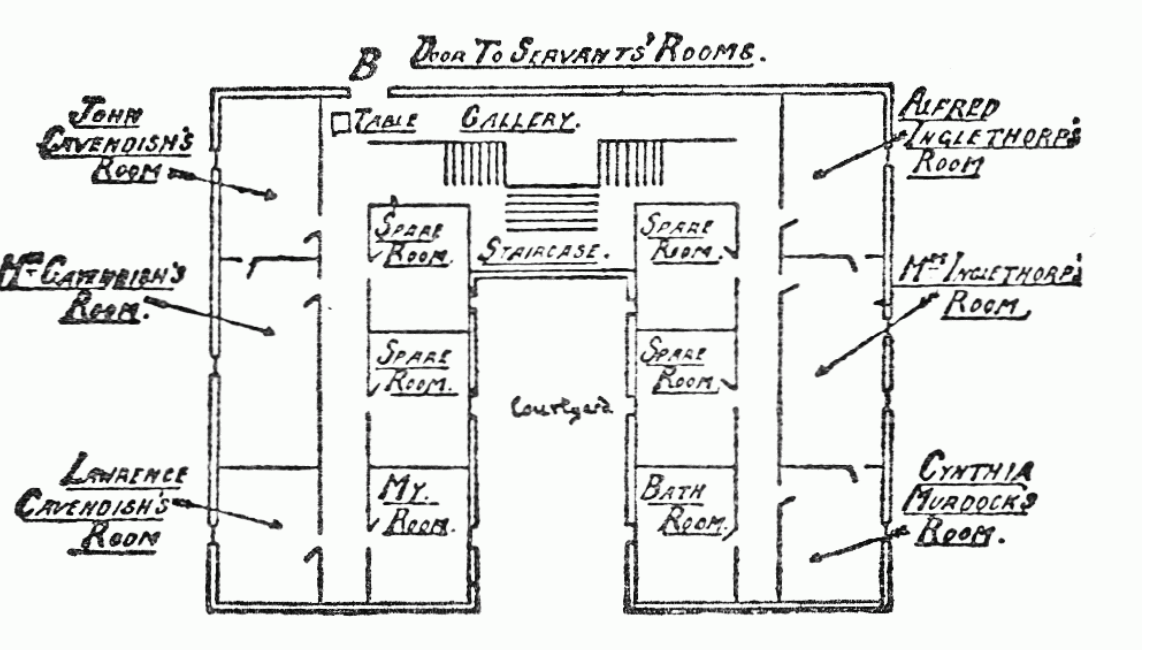
“Yes, sir.”
「はい、旦那様」
“And the table, is it on this side of the door, or on the farther—servants’ side?”
「そのテーブルは、スイングドアのこちら側? それとも奥?つまり使用人通路の方にあるんですか?」
“It’s this side, sir.”
「こちら側です、旦那様」
“What time did you bring it up last night?”
「昨夜、それを上に運んだのは何時でした?」
“About quarter-past seven, I should say, sir.”
「たしか、7時15分ごろだったと思います、旦那様」
“And when did you take it into Mrs. Inglethorp’s room?”
「それをミセス=イングルソープのお部屋に持って入ったのは?」
“When I went to shut up, sir. About eight o’clock. Mrs. Inglethorp came up to bed before I’d finished.”
「戸締まりに行ったときです、旦那様。8時ごろかと。奥様は私が戸締りを終える前にすでに寝室におられました」
“Then, between seven-fifteen and eight o’clock, the cocoa was standing on the table in the left wing?”
「ということは、7時15分から8時の間、ココアは左の建物のテーブルの上にずっと置かれていた?」
“Yes, sir.”
「はい、旦那様」
Annie had been growing redder and redder in the face, and now she blurted out unexpectedly:
アニーの顔はみるみる赤くなっていき、そして突然、思わず口をついて出たように言った。
“And if there was salt in it, sir, it wasn’t me. I never took the salt near it.”
「でも、もしココアに塩が入っていたとしても、私じゃありません!塩なんか近づけてもいません!」
“What makes you think there was salt in it?” asked Poirot.
「どうして君は、ココアに塩が入っていたと思ったのですか?」と、ポワロは尋ねた。
“Seeing it on the tray, sir.”
「トレイの上に、塩がこぼれてたんです、旦那様」
“You saw some salt on the tray?”
「塩?トレイの上に?」
“Yes. Coarse kitchen salt, it looked. I never noticed it when I took the tray up, but when I came to take it into the mistress’s room I saw it at once, and I suppose I ought to have taken it down again, and asked cook to make some fresh. But I was in a hurry, because Dorcas was out, and I thought maybe the cocoa itself was all right, and the salt had only gone on the tray. So I dusted it off with my apron, and took it in.”
「ええ、キッチンで使う粗塩でした。
持って上がったときには気づきませんでしたが、お部屋に持っていくときにすぐ目に入りました。
それで、本当は台所に戻って、新しいのを作ってもらうべきだったのかもしれません。
でも急いでいたんです。ドーカスが出かけていて、私ひとりで全部やっていたもので。それに、ココア自体は無事だと思ったんです。塩はたぶんトレイにだけ落ちてたと思って。
だからエプロンでトレイを拭って、そのままお部屋にお持ちしました」
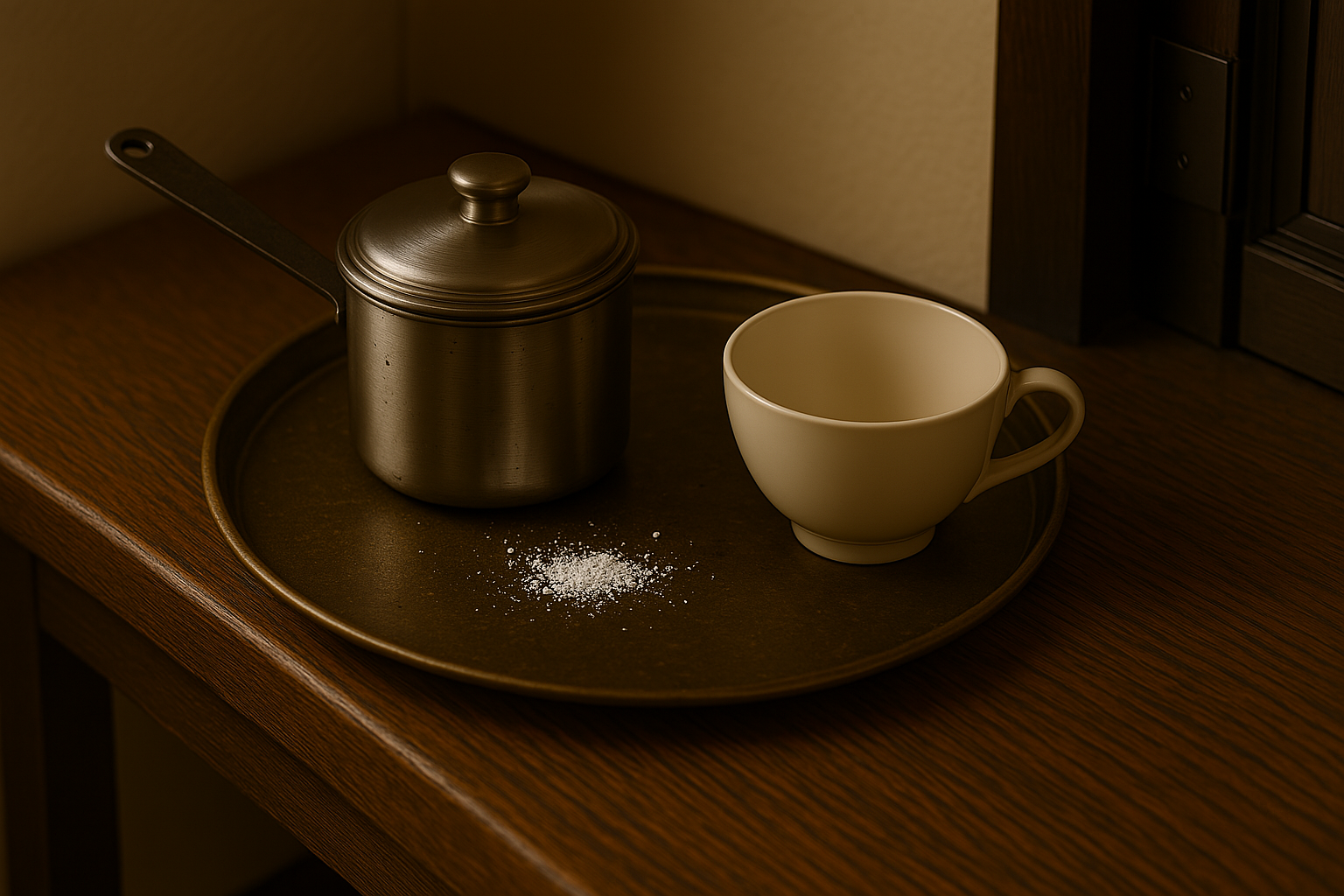
I had the utmost difficulty in controlling my excitement.
Unknown to herself, Annie had provided us with an important piece of evidence.
How she would have gaped if she had realized that her “coarse kitchen salt” was strychnine, one of the most deadly poisons known to mankind.
I marvelled at Poirot’s calm. His self-control was astonishing.
I awaited his next question with impatience, but it disappointed me.
私は、興奮を押さえるのに必死だった。
アニーは自分では気づかないまま、極めて重要な証言をしてくれたのだ。
彼女がもし、あの粗塩が、人類史上もっとも致命的な毒物のひとつ、ストリキニーネだったと知っていたら、どういう顔をしただろう。
私はポワロの冷静さに感心した。
あの落ち着きぶりは、まさに驚異的だ。
私は次の質問をいまかいまかと待ち構えていた。だが、その質問は正直、拍子抜けだった。
“When you went into Mrs. Inglethorp’s room, was the door leading into Miss Cynthia’s room bolted?”
「ミセス=イングルソープのお部屋に入ったとき、ミス=シンシアの部屋に通じるドアはカンヌキがかかっていましたか?」
“Oh! Yes, sir; it always was. It had never been opened.”
「あっ、はい、旦那様。いつもかかってました。あのドアは一度も開けたことがありません」
“And the door into Mr. Inglethorp’s room? Did you notice if that was bolted too?”
「では、ミスター=イングルソープのお部屋に通じるドアは? それもカンヌキがかかっていたかどうか、分かりますか?」
Annie hesitated.
アニーは少し迷ってから言った。
“I couldn’t rightly say, sir; it was shut but I couldn’t say whether it was bolted or not.”
「はっきりとは申し上げられません、旦那様。閉まってはいましたが、カンヌキがかかっていたかどうかまでは」
“When you finally left the room, did Mrs. Inglethorp bolt the door after you?”
「あなたが最後に部屋を出たとき、奥様はそのあと廊下側のドアにカンヌキをかけましたか?」
“No, sir, not then, but I expect she did later. She usually did lock it at night. The door into the passage, that is.”
「いえ、そのときはまだ。でも、あとでかけられたと思います。いつも夜は、廊下側のドアには鍵をかけていらっしゃいましたから」
“Did you notice any candle grease on the floor when you did the room yesterday?”
「昨日、部屋の掃除をしたとき、床にロウのシミはありましたか?」
“Candle grease? Oh, no, sir. Mrs. Inglethorp didn’t have a candle, only a reading-lamp.”
「ロウのシミ、ですって?いいえ、旦那様。奥様はロウソクは使いませんでした。読書用のランプだけでしたから」
“Then, if there had been a large patch of candle grease on the floor, you think you would have been sure to have seen it?”
「ということは、もし床に大きなロウのしみがあったら、確実に気づいていたと?」
“Yes, sir, and I would have taken it out with a piece of blotting-paper and a hot iron.”
「はい、旦那様。もし見つけていたら、吸い取り紙と熱したアイロンで取っていたはずです」
Then Poirot repeated the question he had put to Dorcas:
そのあとポワロは、ドーカスにも聞いたのと同じ質問を繰り返した。
“Did your mistress ever have a green dress?”
「奥様は緑色のドレスをお持ちでしたか?」
“No, sir.”
「いいえ、旦那様」
“Nor a mantle, nor a cape, nor a—how do you call it?—a sports coat?”
「マントやケープ、ああ、なんて言ったっけ、スポーツコートのようなものは?」
“Not green, sir.”
「緑色のものは持っておられませんでした」
“Nor anyone else in the house?”
「この家のどなたかが持っているということは?」
Annie reflected.
アニーは少し考えてから答えた。
“No, sir.”
「ありません、旦那様」
“You are sure of that?”
「確かですか?」
“Quite sure.”
「間違いありません」
“Bien! That is all I want to know. Thank you very much.”
「ビヤン(よろしい、)!知りたいことはこれで十分です。本当にありがとう」
With a nervous giggle, Annie took herself creakingly out of the room.
My pent-up excitement burst forth.
アニーは緊張しながらも小さくクスッと笑い、ギシギシと音を立てて部屋を出ていった。私は抑えていた興奮を我慢できなかった。
“Poirot,” I cried, “I congratulate you! This is a great discovery.”
「ポワロ!」 と、私は叫んだ。
「おめでとう!これはすごい発見じゃないか!」
“What is a great discovery?”
「すごい発見とはなんだい?」
“Why, that it was the cocoa and not the coffee that was poisoned. That explains everything!
Of course it did not take effect until the early morning, since the cocoa was only drunk in the middle of the night.”
「何って、毒が入れられたのはコーヒーじゃなくてココアだったってことだよ。これで全部説明がつくじゃないか!毒の効果が朝まで出なかったのも当然だよ。ココアは夜中になってから飲まれたんだから!」
“So you think that the cocoa—mark well what I say, Hastings, the cocoa—contained strychnine?”
「ほう、つまり君はこう考えているわけだね。ココアに、いいですか、よく聞いて、ヘイスティングス。ココアに、ストリキニーネが入っていた?」
“Of course! That salt on the tray, what else could it have been?”
「もちろんだよ!あのトレイの上の塩は、他に何だって言うんだ?」
“It might have been salt,” replied Poirot placidly.
「それは、ただの塩、かもしれませんな」と、ポワロは平然と答えた。
I shrugged my shoulders. If he was going to take the matter that way, it was no good arguing with him. The idea crossed my mind, not for the first time, that poor old Poirot was growing old. Privately I thought it lucky that he had associated with him someone of a more receptive type of mind.
私は肩をすくめた。こんな風にかわされるようじゃ、議論するだけムダだ。
実はこれが初めてじゃなかったのだけど、ポワロも歳をとったのかな、なんて思いが、ふとよぎった。
まあ、私のように柔軟な発想ができる人間がそばにいるのは、彼にとっても幸運だろうと、心の中で思っていた。
Poirot was surveying me with quietly twinkling eyes.
すると、ポワロが静かにキラリと目を光らせて私を見つめていた。
“You are not pleased with me, mon ami?”
「どうやら不満のようだね、モナミ?」
“My dear Poirot,” I said coldly,“it is not for me to dictate to you. You have a right to your own opinion, just as I have to mine.”
「いや、ねえ、ポワロ」と、私は冷ややかに言った。
「僕が君にどうすべきか指示する立場じゃない。君には君の意見があるし、僕には僕の考えがある」
“A most admirable sentiment,” remarked Poirot, rising briskly to his feet.
“Now I have finished with this room. By the way, whose is the smaller desk in the corner?”
「いやあ、立派なご意見ですな」と、ポワロは言ってすっと立ち上がった。
「さて、この部屋での仕事は終わりです。ところで、あの隅の小さな机、あれは誰のものですか?」
“Mr. Inglethorp’s.”
「ミスター=イングルソープのだよ」
“Ah!”
「ふむ!」
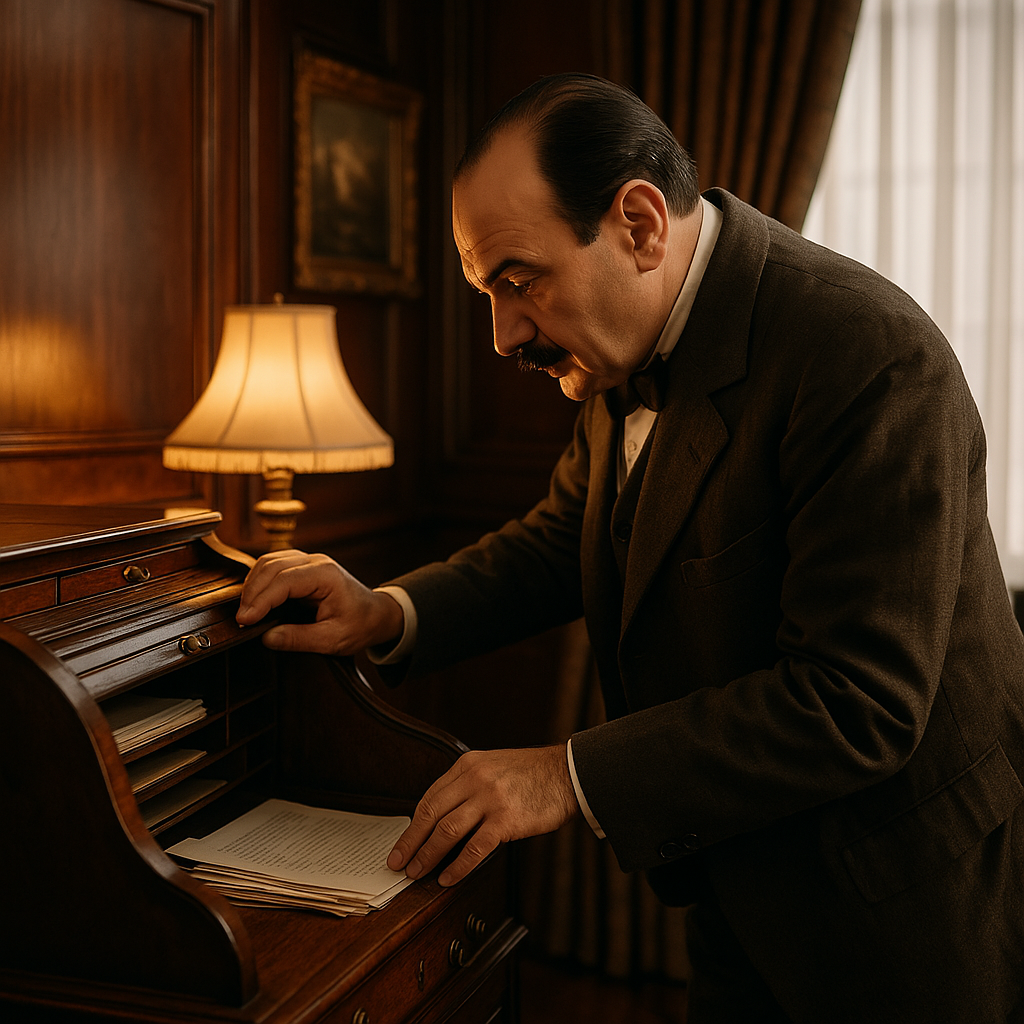
He tried the roll top tentatively.
ポワロは、ロールトップの机(蛇腹式の扉が付いた机)を、ためしに軽くいじっていた。
“Locked. But perhaps one of Mrs. Inglethorp’s keys would open it.”
「鍵がかかっている。だが、ミセス=イングルソープの鍵の中に合うものがあるかもしれない」
He tried the roll top tentatively. “Locked. But perhaps one of Mrs. Inglethorp’s keys would open it.”
彼は数本の鍵を手慣れた手つきで試し、ひねったり回したりして、ついに満足そうに声をあげた。
“Voilà! It is not the key, but it will open it at a pinch.”
「ヴォワラ(ほら)!鍵は違うけど、どうにか開いた」
He slid back the roll top, and ran a rapid eye over the neatly filed papers.
To my surprise, he did not examine them, merely remarking approvingly as he relocked the desk:
彼はロールトップをスライドさせて開けると、中の書類をざっと目で見わたした。
私はてっきり細かく調べるのかと思ったのに、彼は一切手を触れず、机を再び施錠してこう言った。
“Decidedly, he is a man of method, this Mr. Inglethorp!”
「まったく几帳面な男だ、ミスター=イングルソープは!」
A “man of method” was, in Poirot’s estimation, the highest praise that could be bestowed on any individual.
I felt that my friend was not what he had been as he rambled on disconnectedly:
ちなみに 『几帳面な人間』」というのは、ポワロにとっては最高級の褒め言葉だった。
だがそのあとポワロは、どこか独り言のようにぶつぶつと語り続けたので、私はやはり彼が以前ほど冴えていないのではないかという不安を拭えなかった。
“There were no stamps in his desk, but there might have been, eh, mon ami? There might have been? Yes”
「彼の机には切手はなかった。だが、あってもおかしくはなかった、だろう?どうかね、モナミ?あったかもしれない」
—his eyes wandered round the room—
ポワロの目が部屋をさまよい始めた。
“this boudoir has nothing more to tell us. It did not yield much. Only this.”
「ふむ、この書斎から得られることは、もうなさそうだ。収穫は少なかった。ただ、これだけだな」
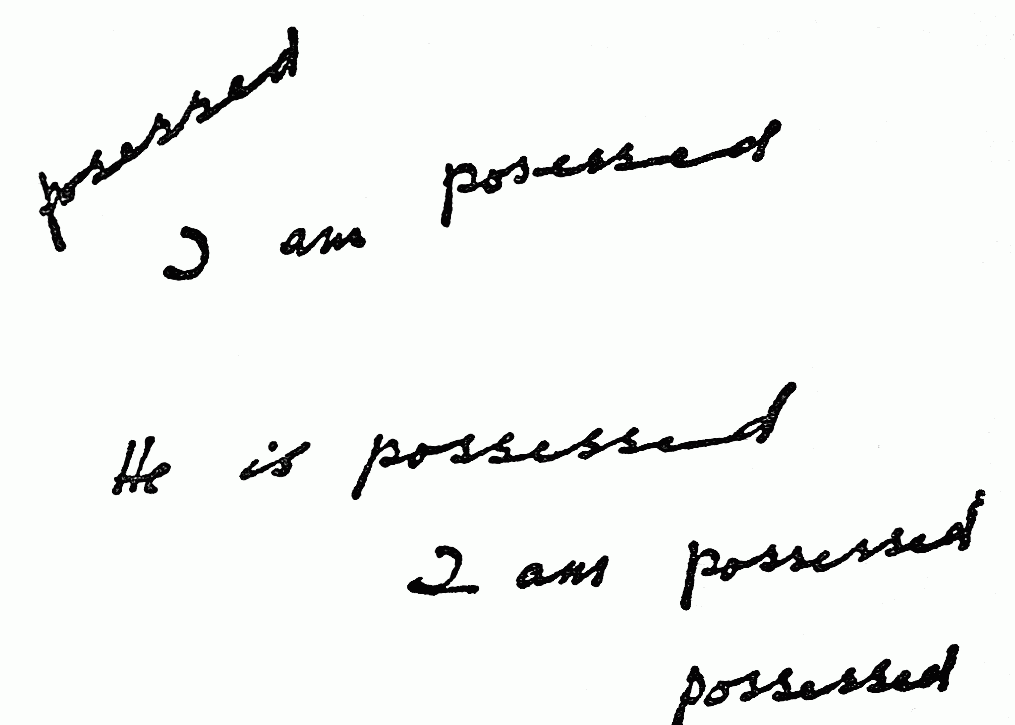
He pulled a crumpled envelope out of his pocket, and tossed it over to me.
It was rather a curious document. A plain, dirty looking old envelope with a few words scrawled across it, apparently at random. The following is a facsimile of it.
そう言ってポワロはしわくちゃの封筒をポケットから取り出して、僕に投げてよこした。
その封筒はとても奇妙な代物だった。
普通の、少しくすんだ汚れた感じの封筒で、表にはランダムに走り書きされたような文字がいくつかあるだけだった。